Atomic Habits by James Clear: How to Build Better Habits That Last

Most people do not struggle because they lack ambition. They struggle because their daily routines repeatedly pull them in the wrong direction. You may want to exercise, read more, eat better, spend less money or reduce your time on your phone—but good intentions often disappear when life becomes busy.
Atomic Habits by James Clear offers a practical way to solve that problem. Its central argument is that lasting change usually comes from improving the small actions you repeat, not from making one dramatic decision. A tiny habit may seem insignificant on a single day, but repeated actions shape your skills, health, relationships, finances and sense of identity over time.
This guide explains the main ideas in the book and, more importantly, how to use them. You will learn the 4 Laws of Behavior Change, how identity-based habits work, why your environment often matters more than motivation, and how to build a realistic habit system that can survive ordinary setbacks.
Atomic Habits by James Clear: Core Ideas, the 4 Laws of Behavior Change, and Identity-Based Habits
What is Atomic Habits about?
Atomic Habits, published by James Clear, is a guide to understanding how habits form and how they can be changed.
The word “atomic” refers to something extremely small, but also potentially powerful. Clear uses the idea to describe small behaviors that can produce meaningful results when repeated consistently. The book is not claiming that one tiny action will transform your life overnight. Instead, it argues that repeated behavior gradually changes your results—and often your identity as well.
The book focuses on several connected ideas:
- Small improvements can accumulate over time.
- Habits are shaped by cues, cravings, responses and rewards.
- Good habits become easier when they are obvious, attractive, easy and satisfying.
- Bad habits can be weakened by reversing those same principles.
- Long-term change is easier when habits support the person you want to become.
- Systems and environments often matter more than motivation alone.
That makes Atomic Habits more useful than a simple collection of inspirational advice. It gives you a framework for diagnosing why a habit is failing and changing the conditions around it.
The core idea: small improvements compound
One of the most memorable concepts in the book is the idea of getting slightly better over time. Clear often uses the phrase “1% better every day” to illustrate how small improvements can compound.
This should be understood as a model, not a promise or a precise formula for personal success. Progress is rarely perfectly linear. Some habits produce results quickly, while others remain invisible for weeks or months. Still, the broader point is valuable: repeated small choices have more influence than occasional bursts of effort.
Consider two approaches to fitness:
- You train intensely for three weeks, then stop for two months.
- You walk for 20 minutes four times a week and gradually add strength training.
The first approach may feel more impressive, but the second is more likely to become part of your life. A manageable routine gives you more opportunities to repeat the behavior, and repetition is what makes a habit more automatic.
The same principle applies to other areas:
- Reading ten pages each evening can produce more learning than buying books you never open.
- Reviewing your spending for five minutes each Friday can be more useful than making a complicated annual budget you abandon.
- Preparing tomorrow’s priorities before bed can reduce morning decision-making.
- Practising a language for 15 minutes a day can create a stronger foundation than occasional long sessions.
Small habits are not valuable because smallness is automatically superior. They are valuable because they lower the resistance to starting and make repetition more realistic.
The habit loop: cue, craving, response and reward
Clear explains habits through a four-stage loop:
- Cue: Something signals that a behavior may be available.
- Craving: You anticipate a change in your state or situation.
- Response: You perform the behavior.
- Reward: You receive some benefit, relief or satisfaction.
For example:
- Cue: You finish dinner.
- Craving: You want to relax.
- Response: You sit on the sofa and open a streaming app.
- Reward: You experience entertainment and a break from the day.
This loop helps explain why simply telling yourself to “use your phone less” may not work. The phone habit may be meeting a real need: rest, stimulation, distraction or social connection. To change it, you need to alter the cue, make the unwanted behavior less convenient, or provide a better way to achieve the same reward.
The 4 Laws of Behavior Change
The central practical framework in Atomic Habits is the 4 Laws of Behavior Change. Each law corresponds to one stage of the habit loop.
To build a good habit:
- Make it obvious.
- Make it attractive.
- Make it easy.
- Make it satisfying.
To break a bad habit, reverse the laws:
- Make it invisible.
- Make it unattractive.
- Make it difficult.
- Make it unsatisfying.
1. Make it obvious
A habit is easier to perform when the cue is clear and visible.
A useful starting point is to define exactly when and where the behavior will happen. This is sometimes called an implementation intention:
I will [behavior] at [time] in [location].
Examples:
- I will read two pages at 9:30 p.m. in bed.
- I will walk for 15 minutes after lunch on Monday, Wednesday and Friday.
- I will practise guitar for ten minutes after making coffee.
- I will review my task list at 8:45 a.m. at my desk.
Vague intentions such as “I should exercise more” leave too many decisions for the moment when action is required. A specific plan removes some of that uncertainty.
You can also use visual cues:
- Put your running shoes beside the door.
- Keep a book on your pillow.
- Place a water bottle on your desk.
- Put your guitar where you can see it.
- Keep fruit at eye level and less nutritious snacks out of immediate reach.
A habit scorecard can help identify existing patterns. Write down the routine parts of your day—waking, commuting, meals, work, exercise, screen use and bedtime—and note which behaviors help or hinder your goals. The purpose is not to judge yourself. It is to discover the cues already controlling your behavior.
2. Make it attractive
We are more likely to repeat an action when we associate it with something enjoyable or meaningful.
One way to do this is temptation bundling: pair a habit you should do with something you already want to do.
Examples:
- Listen to a favorite podcast only while walking.
- Play music you enjoy while preparing meals.
- Have your morning coffee after completing a short mobility routine.
- Watch a television show while folding laundry or using a stationary bike.
The pairing must remain practical. If the enjoyable activity completely overwhelms the useful one, it may become a distraction rather than a support.
Social settings also affect attractiveness. Behaviors seem more appealing when they are normal within the groups we spend time with. If you want to read, join a book group or spend more time with people who discuss ideas. If you want to train, exercising with a reliable partner may make the routine more engaging.
This does not mean you need to change your entire social circle. It may simply mean finding one environment in which the behavior you want is treated as ordinary.
3. Make it easy
When a habit requires too many steps, it becomes vulnerable to tiredness, interruptions and competing priorities.
The solution is not necessarily to lower your standards permanently. It is to reduce the friction involved in starting.
Examples:
- Prepare gym clothes the night before.
- Keep a notebook and pen beside your chair.
- Store healthy ingredients together for quick meals.
- Save your study materials in one clearly labelled folder.
- Use automatic transfers for regular saving where appropriate.
- Remove unnecessary apps from your phone’s home screen.
Clear’s “two-minute rule” is useful here: scale a new habit down to an action that takes roughly two minutes to begin.
- “Read before bed” becomes “read one page.”
- “Train for a marathon” becomes “put on running shoes.”
- “Clean the kitchen” becomes “wash one dish.”
- “Learn coding” becomes “open the lesson and complete one exercise.”
The purpose is not to pretend that one page or one dish completes the larger goal. It is to create a reliable starting ritual. Once starting becomes familiar, you can gradually expand the activity.
Be careful not to confuse preparation with progress. Organizing a study plan is not the same as studying. Buying exercise equipment is not the same as exercising. Preparation is useful when it leads quickly to action; it becomes avoidance when it replaces action.
4. Make it satisfying
A behavior is easier to repeat when it produces an immediate sense of completion or reward.
Many beneficial habits have delayed rewards. Exercise may improve health over time, saving may increase financial security gradually, and learning may not produce visible results for months. That delay can make good behaviors feel less satisfying than habits with immediate rewards.
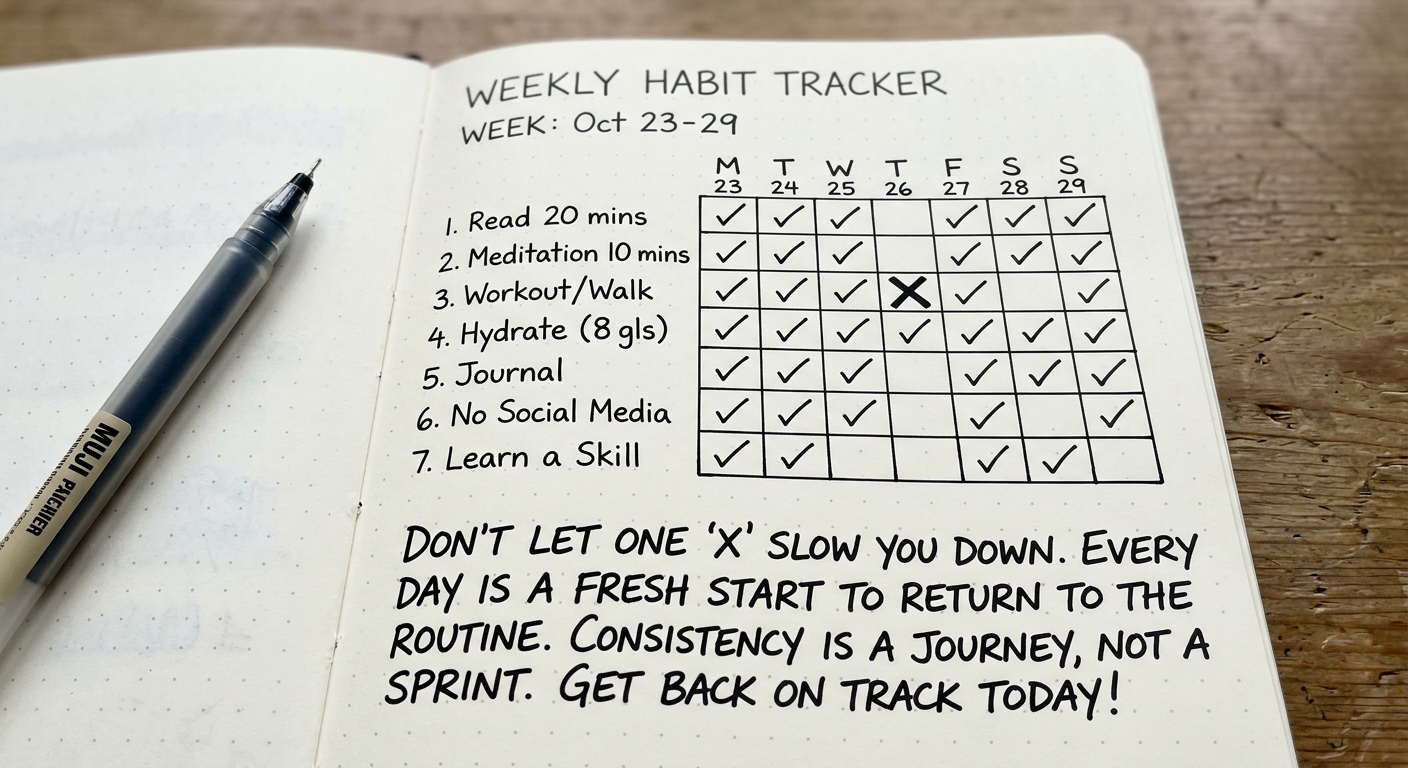
A simple tracking system can provide immediate feedback:
- Mark an X on a calendar.
- Record workouts in a notebook.
- Track reading sessions rather than only books completed.
- Record each week that you stayed within a planned spending limit.
- Use a checklist for a short evening shutdown routine.
Tracking is a tool, not the goal. If tracking becomes complicated, reduce it to one visible measure. You can also use the principle “never miss twice.” Missing one workout or study session is normal. The danger is allowing one missed session to become a new pattern. The next opportunity is usually more important than self-criticism about the previous one.
Reversing the laws to break bad habits
The same framework can help you break bad habits.
Make the habit invisible
Remove or hide the cue.
- Keep your phone outside the bedroom.
- Log out of distracting websites.
- Do not store snacks on your desk.
- Turn off non-essential notifications.
- Avoid leaving shopping apps open when you are trying to spend less.
This works because many unwanted behaviors begin before conscious deliberation. If the cue is not constantly present, you have fewer automatic prompts to respond to.
Make it unattractive
Examine the immediate and longer-term cost of the habit.
Instead of describing late-night scrolling as “relaxing,” ask what it actually produces: a later bedtime, a less settled morning or reduced time for something you value. This is not about shame. It is about making the full consequence visible rather than focusing only on the short-term reward.
You can also replace the habit with a behavior that meets the underlying need more effectively. If you reach for your phone because you need a break, try a short walk, music, stretching or a conversation.
Make it difficult
Add friction between yourself and the behavior.
- Use website blockers during focused work.
- Keep gaming equipment disconnected when you need to study.
- Do not save payment details in stores where you overspend.
- Charge your phone in another room.
- Put tempting food in a less accessible location.
- Set a rule that you must wait 24 hours before making a non-essential purchase.
The goal is not to rely on heroic self-control. It is to make the unwanted action require an extra decision.
Make it unsatisfying
Create an immediate consequence or accountability mechanism.
You might tell a trusted friend what you are trying to change, use a written commitment or establish a small consequence for breaking a clearly defined rule. Accountability works best when the rule is specific. “I will be more disciplined” is difficult to evaluate. “I will not use social media during the first 30 minutes after waking” is clearer.
Avoid turning habit change into punishment. A system should help you notice the behavior and adjust it, not create unnecessary guilt.
Identity-based habits
One of the most important ideas in Atomic Habits is the distinction between outcome-based, process-based and identity-based change.
- Outcome: What you want to achieve.
- Process: What you do regularly.
- Identity: The kind of person you believe yourself to be.
For example:
- Outcome: Complete a 10-kilometre race.
- Process: Follow a realistic running schedule.
- Identity: Become someone who trains consistently.
Goals can provide direction, but identity can make the behavior feel more connected to who you are becoming.
Instead of saying:
- “I want to read more,” think, “I am becoming a reader.”
- “I want to exercise,” think, “I am someone who takes care of his body.”
- “I want to write,” think, “I am a person who writes regularly.”
- “I want to save money,” think, “I am someone who plans before spending.”
This is not about making a flattering statement and waiting for behavior to change. The identity becomes credible through evidence. Every time you read a page, complete a workout or transfer money into savings, you cast a small vote for that identity.
The approach also avoids a common trap: defining yourself by a failed attempt. Missing a workout does not prove that you are lazy. It proves that one planned workout did not happen. A more useful response is to examine the system: Was the session too ambitious? Was the time poorly chosen? Was the cue missing? Was there no backup plan?
How to Apply Atomic Habits to Build Better Habits, Break Bad Ones, and Create Lasting Change
The ideas become useful when translated into specific routines. Start with one behavior that matters and design the surrounding system.
Exercise
Rather than setting an ambitious target such as “train every day,” define a minimum version you can repeat.
A practical setup might look like this:
- Cue: After changing out of work clothes.
- Obvious step: Keep training clothes ready.
- Easy version: Complete five minutes of movement.
- Standard version: Follow a 30-minute workout three times a week.
- Reward: Mark the session on a visible calendar and take a relaxing shower.
The minimum version is not intended to replace meaningful training forever. It protects the habit during busy periods. On good days, you can do more. On difficult days, you preserve the routine by completing the smallest useful version.
Reading
Reading often fails because it competes with easier entertainment.
Try:
- Choose one book rather than keeping several unfinished books beside the bed.
- Put it somewhere visible.
- Read after a stable cue, such as brushing your teeth.
- Begin with two pages.
- Keep your phone out of reach.
- Stop while the routine still feels manageable if you are building consistency.
If you want to retain more, write one sentence after each reading session: “The main point was…” This adds a small amount of effort but makes passive reading more deliberate.
For a broader personal-development reading list, link this section naturally to ManStuff101’s “10 Best Self-Improvement Books to Read in 2026”.
Productivity and focused work
Productivity habits should reduce uncertainty, not fill your day with complicated rituals.
A useful work system might include:
- Choose the most important task the evening before.
- Define the first physical action, such as “open the project brief and write the heading.”
- Start with a 25-minute focus block.
- Keep messaging apps closed during that block.
- Record what you completed before switching tasks.
The first action should be concrete. “Work on the business” is too broad. “Draft the opening paragraph of the proposal” gives your brain a clear entry point.
You can also create a shutdown habit:
- Review unfinished tasks.
- Move important items to tomorrow’s list.
- Close work applications.
- Tidy the desk for two minutes.
- Decide when work resumes.
This reduces the temptation to keep mentally working late into the evening.
Healthy eating
Food habits are strongly influenced by convenience and visibility.
Useful changes include:
- Plan two or three reliable breakfasts and lunches.
- Shop with a short list.
- Prepare ingredients when you return from the supermarket.
- Keep water available.
- Store foods you want to eat more often where you can see them.
- Avoid eating directly from large packages.
- Decide in advance what you will do when you are tired or short on time.
A backup meal is especially valuable. If your only healthy option requires extensive cooking, the easiest available food will often win when you are hungry. A simple meal you can prepare quickly may be more useful than an ideal plan you cannot follow.
Learning a new skill
Skill-building requires regular contact with the material and enough difficulty to create learning.
Use a clear cue and a modest starting target:
- Practise after your morning coffee.
- Complete one lesson or ten minutes of deliberate practice.
- Keep the instrument, notebook or software ready.
- End each session by writing down the next step.
- Review progress weekly rather than judging every session.
Do not spend all your time consuming information about the skill. A good habit should include practice, feedback and correction—not only videos, books or equipment research.
Saving money
Habit design can make financial decisions more automatic, but it cannot substitute for a realistic budget or professional advice where your circumstances are complex.
Practical applications include:
- Review spending at the same time each week.
- Automate a suitable transfer on payday.
- Remove saved payment details from impulse-shopping websites.
- Add a waiting period before non-essential purchases.
- Keep a short list of financial priorities visible.
- Track one meaningful measure, such as weekly discretionary spending.
The point is to make the desired action happen before temptation or forgetfulness takes over. If you change the amount or timing of any automated transfer, make sure it fits your income, expenses and obligations.
Reducing screen time
Trying to use your phone less through willpower alone is difficult because the device is designed to be convenient and attention-grabbing.
Use environmental changes:
- Remove high-distraction apps from the home screen.
- Disable notifications that are not genuinely necessary.
- Keep the phone away during meals and focused work.
- Charge it outside the bedroom.
- Set specific times for checking messages.
- Replace the cue with a prepared alternative, such as a book, walk or conversation.
Measure the behavior you actually want to change. “Use my phone less” is vague; “no social media before breakfast” or “phone stays outside the bedroom overnight” is testable.
Habit stacking: connect a new habit to an existing routine
Habit stacking means attaching a new behavior to a habit you already perform reliably.
The basic formula is:
After I [current habit], I will [new habit].
Examples:
- After I make coffee, I will review my top priority.
- After I brush my teeth, I will stretch for two minutes.
- After I sit at my desk, I will write the first task on a notepad.
- After I finish lunch, I will walk around the block.
- After I turn off my computer, I will prepare tomorrow’s clothes.
Choose a stable anchor. “After I wake up” may be less reliable than “after I make coffee,” especially if your mornings vary. The new action should also be appropriately small. If the habit takes 45 minutes, it may be too large to attach to a quick existing routine.
Once the sequence is established, you can expand it. A two-minute stretch can become a longer mobility session. A one-page reading habit can become ten pages. Start with a connection you can maintain.
Why your environment often matters more than motivation
Motivation fluctuates with sleep, stress, workload and mood. Your environment is present more consistently.
If fruit is washed and visible, eating it requires fewer steps. If your phone is beside your bed, checking it requires almost no effort. If your running shoes are buried in a cupboard, starting a run requires an extra decision before the run even begins.
Design your surroundings around the behavior you want:
- Increase visibility for good habits.
- Reduce the number of steps involved.
- Prepare the first action in advance.
- Remove cues for unwanted habits.
- Add friction to behaviors that regularly derail you.
- Put important tools in the location where they will be used.
This is not an excuse to ignore personal responsibility. It is a more realistic understanding of responsibility. If you know a particular environment repeatedly leads to a behavior you regret, changing the environment is a sensible response.
Habits and goals: what is the difference?
Goals describe an outcome. Systems describe the recurring process that should produce it.
A goal might be:
- Lose a certain amount of weight.
- Complete a qualification.
- Save for a purchase.
- Run a particular distance.
- Read 20 books.
A system might be:
- Prepare weekday meals on Sunday.
- Study for 30 minutes after dinner.
- Transfer money on payday.
- Run on set days.
- Read before bed.
Goals are useful for choosing a direction, but they have limitations:
- They can make success feel distant.
- They often encourage all-or-nothing thinking.
- They do not explain what to do today.
- They can create a temporary push without a sustainable routine.
- Reaching the goal does not automatically preserve the behavior.
A system turns a desired outcome into repeatable actions. The best approach is usually not “ignore goals completely,” but use goals for direction and systems for daily execution.
Common mistakes when applying Atomic Habits
Starting with too many habits
Changing exercise, diet, sleep, spending, reading and screen use at the same time creates a large burden of decisions. Choose one keystone behavior or one area that would make other changes easier.
Making the habit too ambitious
A plan that works only on your best days is not a reliable system. Create a minimum version for busy days and a fuller version for normal days.
Relying on motivation
Motivation can help you begin, but a clear cue, convenient setup and low-friction first step make repetition more likely.
Tracking without changing the system
A streak does not fix a poorly designed habit. If you repeatedly miss the behavior, ask whether the time, location, difficulty or cue needs to change.
Treating one miss as failure
A missed day is information. It may reveal that your plan is unrealistic or that your cue is unstable. Resume at the next opportunity rather than waiting for a new week or month.
Confusing identity with self-labelling
Calling yourself “a disciplined person” does not make a habit automatic. Identity is built through repeated evidence. Let your actions gradually support the description.
A practical 14-day habit experiment
Use the following process to test one habit without redesigning your entire life:
- Choose one behavior. Make it specific and observable.
- Define the identity behind it. Ask what kind of person would naturally perform this action.
- Select a stable cue. Use an existing routine, time or location.
- Make the first step obvious. Put the required object or reminder in position.
- Reduce the habit to two minutes. Create a version you can begin even on a difficult day.
- Remove one obstacle. Prepare equipment, simplify the task or change the location.
- Add a small immediate reward. Track completion or use a satisfying end ritual.
- Record what happens. Note when you missed the habit and why.
- Adjust once a week. Change the system, not just your level of self-criticism.
- Use a backup rule. Decide what you will do when the normal version is impossible.
After 14 days, assess whether the habit is easier to start, whether the cue is reliable and whether the minimum version is correctly sized. Then decide whether to expand it or continue reinforcing the basic routine.
The most important lessons from Atomic Habits
The book’s main lessons can be summarized as follows:
- Small actions matter when they are repeated. The value is in the pattern, not the drama of one attempt.
- Design the cue. A clear time, place or existing routine makes a behavior easier to remember.
- Reduce friction. The easier a habit is to start, the more likely you are to repeat it.
- Use the environment. Make good choices visible and convenient; make unwanted choices less accessible.
- Start smaller than your ambition. A habit must survive busy and inconvenient days.
- Build identity through evidence. Each repetition reinforces the kind of person you are becoming.
- Track carefully. Measurement can provide feedback, but it should not become a substitute for the behavior.
- Expect imperfect progress. Missing once is normal; returning quickly protects the pattern.
- Use goals for direction and systems for execution.
- Solve the real problem. If a bad habit provides rest, connection or relief, create a healthier way to meet that need.
Is Atomic Habits worth reading in 2026?
Yes, especially if you want a practical introduction to habit building strategies and behavior change.
The book is most useful for readers who:
- Start new routines but struggle to maintain them.
- Set goals without establishing daily actions.
- Want a clear framework for building better habits.
- Need practical ways to make unwanted behaviors less convenient.
- Prefer systems and examples to abstract motivation.
- Want to connect personal development with everyday routines.
It is not a complete answer to every problem. Some obstacles are caused by demanding work, financial pressure, health concerns, family responsibilities, stress or conditions that require specialized support. A habit framework can help with behavior design, but it should not be treated as a cure-all or as proof that every difficulty is a matter of personal discipline.
As an Atomic Habits book review, the fairest conclusion is that its ideas are useful because they are simple enough to apply and flexible enough to adapt. The main risk is reading the book as an intellectual project—highlighting every page, building an elaborate tracker and then changing nothing. Its value comes from testing one small behavior in your actual life.
Frequently Asked Questions
What is the main message of Atomic Habits?
The main message is that lasting improvement usually comes from designing and repeating small behaviors. Clear argues that systems, cues, environment and identity can make habits easier to maintain than relying on motivation or ambitious goals alone.
What are the 4 Laws of Behavior Change?
The four laws are:
- Make it obvious.
- Make it attractive.
- Make it easy.
- Make it satisfying.
To break a bad habit, reverse them: make it invisible, unattractive, difficult and unsatisfying.
How long does it take to build a habit?
There is no single reliable timetable that applies to everyone or every behavior. The time required depends on the habit, the person, the context and how often the action is repeated. Focus on creating a repeatable system rather than expecting automatic behavior by a particular date.
What is an example of identity-based habit formation?
Instead of focusing only on “I want to read 12 books,” adopt the identity “I am becoming a reader.” Then provide evidence through a small repeated action, such as reading two pages before bed.
Can Atomic Habits help break bad habits?
It can provide useful strategies. Remove cues, make the behavior less appealing, add friction and create an immediate accountability mechanism. It also helps to identify the reward you are seeking and find a better way to achieve it.
What is habit stacking?
Habit stacking connects a new behavior to an existing routine. For example: “After I brush my teeth, I will stretch for two minutes.” The established routine acts as the cue for the new habit.
Is Atomic Habits one of the best books for self-improvement?
It is a strong choice for readers who want a practical framework for everyday behavior change. Whether it is the best fit depends on your needs. Readers looking for a wider selection can compare it with other titles in ManStuff101’s “10 Best Self-Improvement Books to Read in 2026.”
Where can I learn more about the book’s framework?
For the original explanations, examples and worksheets, consult James Clear’s official material and the book itself. An authoritative source is especially useful when you want to distinguish Clear’s own framework from simplified summaries and social-media advice.
What should I do first after reading Atomic Habits?
Choose one habit, define the smallest version, attach it to a stable cue and prepare the environment before the first attempt. Then run the experiment for two weeks and adjust the system based on what actually happens.
Atomic Habits is most useful when treated as a design manual rather than a motivational speech. Decide what behavior you want, identify the cue that should trigger it, make the first step easy, and arrange your environment so the better choice requires less effort.
Start with one habit today. Write down the exact action, time and location—for example, “After I make coffee tomorrow, I will read two pages at the kitchen table.” Prepare the necessary object tonight, complete the smallest version, and use the result to improve the system. That modest experiment is the practical beginning of building better habits that last.