The “best airline in the world” depends on what you actually need from a flight. A superb business-class cabin may not matter if the airline has an inconvenient connection, expensive checked bags, or weak service on your route. Conversely, an airline with a less glamorous reputation may be the smarter choice because it offers a nonstop flight at a much lower total price.
This guide ranks the 10 best airlines in the world in 2026 using a practical editorial view of long-haul service, seat comfort, reliability, onboard experience, network usefulness, airport connections, and overall value. It is not presented as a permanent or official league table. Airline schedules, aircraft, routes, punctuality and cabin products change regularly, so the best option for your trip still depends on the specific flight you book.
For most travelers, the shortlist begins with Qatar Airways, Singapore Airlines, Emirates, ANA and Cathay Pacific. But the right choice may be Japan Airlines for a quieter economy experience, Turkish Airlines for route coverage and value, or Delta for a strong North American network.
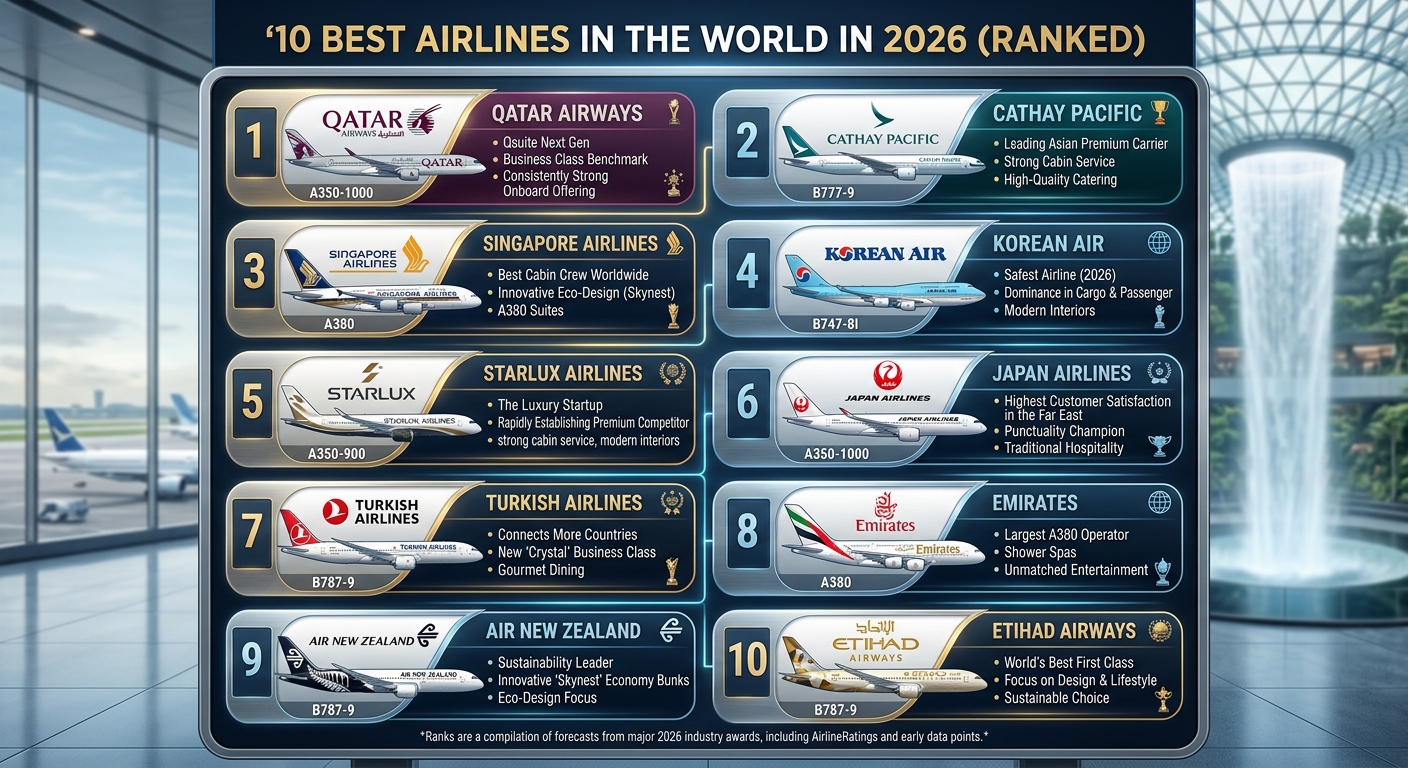
The 10 Best Airlines in the World in 2026, Ranked by Service, Comfort, Reliability, and Value
How this ranking was assessed
The ranking considers five practical factors:
- Service: How consistently the airline delivers professional, efficient and considerate service.
- Comfort: Seat design, cabin cleanliness, food, entertainment, sleep quality and the overall experience in economy, premium economy and business class.
- Reliability: Schedule quality, disruption management and the consistency of the experience. No airline is immune to delays.
- Network and connections: Useful routes, sensible hubs, connection times and access to major destinations.
- Value: What travelers receive for the total ticket price, including baggage, seat selection, meals, lounges and upgrade costs.
A major warning: airline quality can vary by route, aircraft and cabin. The same carrier may offer an excellent A350 business-class product and a much less impressive older aircraft on another route.
1. Qatar Airways
Best overall for long-haul service and business class
Qatar Airways remains one of the strongest all-round choices for international travel, particularly for passengers flying through Doha. Its reputation is built on polished service, a broad long-haul network and a business-class product that is often among the most competitive in the market.
Its Qsuite business-class seats are particularly attractive for travelers who value privacy. Selected aircraft and routes offer enclosed suites, sliding doors and configurations that can work well for solo travelers, couples or colleagues. However, Qsuite is not available on every Qatar Airways aircraft, so checking the specific plane before booking is essential.
Why it ranks first:
- Strong long-haul network across Europe, Asia, Africa, the Middle East and beyond.
- Excellent business-class privacy on aircraft fitted with Qsuite.
- Generally polished airport and onboard service.
- Doha is a useful connecting hub for many international itineraries.
- Competitive premium-cabin experience compared with other top-tier airlines.
What to watch:
- A connection through Doha may add several hours compared with a nonstop flight.
- Economy value depends heavily on fare rules, baggage allowance and seat-selection charges.
- The aircraft operating your route matters; not every flight includes the best business-class product.
Best for: Long-haul business travelers, travelers connecting between regions, and passengers who prioritize service over the shortest possible itinerary.
2. Singapore Airlines
Best for consistently refined service
Singapore Airlines is one of the safest recommendations for travelers who want a calm, polished and carefully managed flying experience. Its reputation is especially strong in premium cabins, but its economy product is also generally regarded as comfortable and well organized.
The airline serves Singapore’s Changi Airport, one of the world’s major connecting hubs. For many passengers, this makes it a practical bridge between Europe, Asia, Australia and other destinations.
Singapore Airlines is not always the cheapest option. Its value improves when the nonstop or one-stop routing is convenient, the fare includes a useful baggage allowance, or the premium-cabin price is reasonable compared with competitors.
Why it ranks highly:
- Consistently professional cabin service.
- Strong food, entertainment and cabin presentation.
- Comfortable premium economy and business-class options on many long-haul routes.
- Excellent hub airport for Asia-Pacific connections.
- A strong choice for travelers who value consistency rather than novelty.
What to watch:
- Premium fares can be expensive.
- Not every aircraft has the same seat design or business-class layout.
- A longer connection in Singapore can reduce the benefit of an otherwise excellent airline.
Best for: Travelers who want a dependable full-service airline, especially on routes between Europe, Asia and Australia.
3. Emirates
Best for entertainment, long-haul connectivity and premium-cabin appeal
Emirates is one of the most recognizable global airlines for good reason. Its Dubai hub connects a large number of cities across Europe, Asia, Africa, the Middle East and the Americas. That network makes Emirates useful when a nonstop flight is unavailable or when several competing airlines require awkward connections.
The airline is particularly strong on entertainment, with a large selection available through its inflight system on many aircraft. Its A380 aircraft also provide distinctive premium-cabin features, including onboard bars in selected business-class configurations and shower spas for eligible first-class passengers.
Why it ranks highly:
- Extensive global network through Dubai.
- Strong inflight entertainment.
- Good choice for passengers who enjoy the A380 experience.
- Attractive first-class and business-class products on selected aircraft.
- Generally straightforward for multi-region itineraries.
What to watch:
- Emirates has a large and varied fleet, so cabin quality can differ substantially.
- Dubai connections may be long or tiring depending on the schedule.
- Some economy fares may look attractive until baggage, seat selection and flexibility are considered.
- The best premium features are limited to certain aircraft and cabins.
Best for: Travelers who want broad route coverage, a strong entertainment system or a premium experience on a suitable aircraft.
4. All Nippon Airways (ANA)
Best for quiet, high-quality travel to Japan
ANA is one of the strongest choices for Japan and for connecting between Japan and other parts of Asia, North America and Europe. It is known for attentive service, good cabin standards and a generally calm onboard experience.
Its business-class product has received attention for private suites on selected aircraft, but travelers should verify whether their specific flight includes the newer seat. Older aircraft and different routes can offer a different experience.
ANA can be especially appealing in economy, where clean cabins, disciplined service and a quieter atmosphere matter more than flashy extras.
Why it ranks highly:
- High-quality service and cabin presentation.
- Strong routes to Japan and useful Asia-Pacific connections.
- Good reputation for cleanliness and professionalism.
- Competitive premium-cabin products on selected aircraft.
- Narita and Haneda offer access to different parts of the Tokyo region, which can be important when planning ground transport.
What to watch:
- Haneda and Narita are not interchangeable for every traveler.
- Some connections within Japan may require a change of airport or a long ground transfer.
- The best premium seats are not available on every route.
- ANA fares can be less competitive than those of other carriers during peak travel periods.
Best for: Travelers visiting Japan, passengers who value a quiet cabin, and people who prefer precise, orderly service.
5. Cathay Pacific
Best for Hong Kong connections and a strong premium experience
Cathay Pacific is a compelling option for routes involving Hong Kong, mainland China connections where available, Southeast Asia and long-haul markets. The airline offers a well-regarded premium-cabin experience and a useful hub at Hong Kong International Airport.
Cathay’s strength is not just the seat or meal. It is the combination of a major Asian hub, a generally sophisticated service style and practical access to a broad regional network.
Why it ranks highly:
- Strong Hong Kong hub and Asia-Pacific connectivity.
- Comfortable long-haul experience on many newer aircraft.
- Attractive business-class product.
- Good airport facilities for premium passengers.
- A useful alternative to Singapore Airlines, ANA and other major Asian carriers.
What to watch:
- Hong Kong may not be the most efficient connection for every itinerary.
- Route schedules and aircraft can change.
- Travelers should compare total journey time rather than focusing only on the airline’s reputation.
- Transit requirements and entry rules should be checked before booking, particularly on complicated itineraries.
Best for: Travelers flying to or through Hong Kong and passengers seeking a polished Asian full-service airline.
6. Japan Airlines
Best for comfortable economy travel and Japan-focused itineraries
Japan Airlines, commonly known as JAL, is an excellent choice for travelers who prioritize comfort, courtesy and a less hectic onboard experience. It is especially strong for flights to Japan and for connections within the country.
JAL is often worth considering in economy, where details such as seat comfort, cabin discipline, meal service and attentive staff can make a long flight noticeably easier. Its premium cabins are also competitive, especially on aircraft equipped with newer suites.
Why it ranks highly:
- Strong service culture and well-presented cabins.
- Good economy experience on many international routes.
- Convenient access to Japan and domestic connections.
- Useful choice for passengers who want a calmer flight.
- Membership in the oneworld alliance can help travelers using partner miles or connecting with other alliance airlines.
What to watch:
- Check whether your ticket includes the baggage allowance you need.
- A domestic connection can involve a significant transfer at a Japanese airport.
- The best seat products are aircraft-specific.
- JAL may not have the broadest network for travelers whose trip does not involve Japan.
Best for: Economy travelers flying to Japan, passengers who value calm service, and oneworld members.
7. Air France
Best for European connections, food and premium travel
Air France is one of the better choices for reaching France and connecting across Europe, Africa, North America and parts of Asia. Paris Charles de Gaulle can be a complicated airport, but the airline’s network and premium service make it highly competitive when the schedule works.
Air France is particularly attractive to travelers who care about food, wine and a more distinctive onboard identity. Its long-haul business class can be excellent on aircraft fitted with its newer seats, while premium economy may appeal to passengers who want more space without paying for business class.
Why it ranks highly:
- Strong global network through Paris.
- Distinctive food and beverage offering.
- Competitive business-class experience on selected aircraft.
- Useful connections throughout Europe and Africa.
- Good option for travelers who prefer a full-service European airline.
What to watch:
- Charles de Gaulle connections can require time and careful navigation.
- Not every aircraft has the newest seat or cabin.
- Strikes and operational disruption have historically been considerations for some European travelers, so flexibility matters.
- Compare the connection airport and total travel time with alternatives such as Amsterdam, Frankfurt, Zurich or Istanbul.
Best for: Travelers visiting France, passengers connecting to Africa, and those who value food and a refined European service style.
8. Turkish Airlines
Best for network reach and competitive international fares
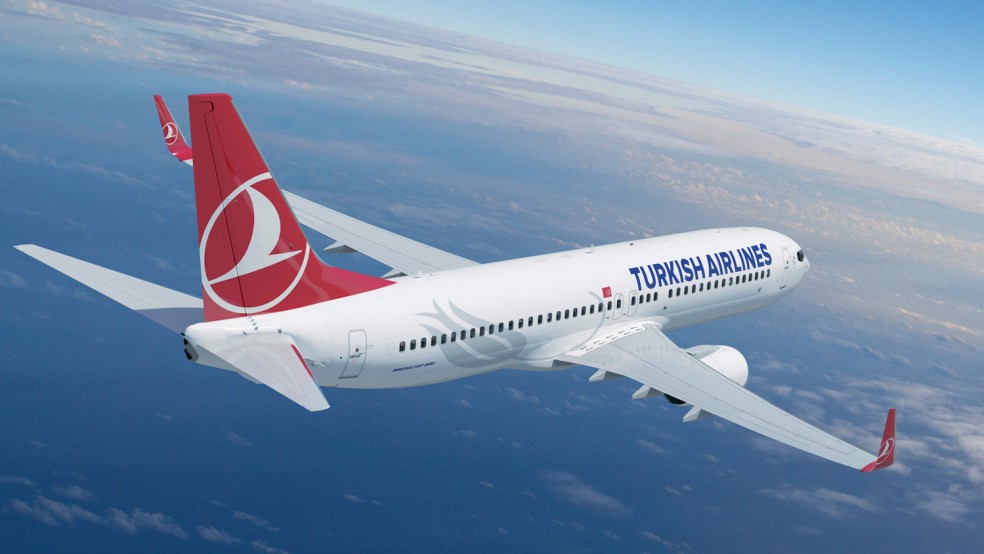
Turkish Airlines is one of the most useful airlines for travelers who need to connect between Europe, Asia, Africa and the Middle East. Istanbul’s location gives it an unusually broad geographic reach, and fares can be competitive compared with other major full-service carriers.
Its catering and business-class service are often notable strengths. For travelers comparing itineraries, Turkish Airlines can offer a useful combination of one-stop access and reasonable pricing.
Why it ranks highly:
- Very broad international network.
- Istanbul is geographically useful for many Europe-Asia and Europe-Africa trips.
- Often competitive pricing in economy and business class.
- Good food and full-service inclusions on many international fares.
- Strong option when other airlines require two connections.
What to watch:
- Istanbul Airport is large, so short connections may be stressful.
- A low headline fare may come with less flexibility or limited seat selection.
- The experience can vary by aircraft and route.
- A connection through Istanbul may be less attractive than a nonstop flight even if the fare is cheaper.
Best for: Travelers who need unusual international routes, want one-stop access, or are comparing value across Europe, Asia and Africa.
9. Etihad Airways
Best for a more intimate premium-cabin experience
Etihad Airways is a strong premium option for travelers using Abu Dhabi as a gateway. It does not have the same network scale as Emirates or Qatar Airways, but its smaller, more curated feel can be an advantage on the right route.
The airline is especially worth comparing in business class and first class, where privacy, presentation and service can be more important than sheer network size. It may also provide a convenient alternative when Dubai or Doha schedules do not line up.
Why it ranks highly:
- Attractive premium-cabin experience on selected aircraft.
- Abu Dhabi can be a practical connection point.
- Often competitive with other Gulf carriers on long-haul routes.
- Good choice for passengers who prefer a less massive hub experience.
- Useful network linking Europe, Asia, the Middle East and other markets.
What to watch:
- Route availability is more limited than Emirates or Qatar Airways.
- Aircraft differences are important.
- A connection through Abu Dhabi is not automatically convenient for every destination.
- Compare the full schedule and arrival time, not just the fare.
Best for: Business-class travelers, passengers connecting through Abu Dhabi and travelers comparing Gulf-carrier options.
10. Delta Air Lines
Best for North American networks and practical reliability
Delta is a different kind of top-ten airline from the international carriers above. Its main strength is not a global hub in the Gulf or Asia, but a substantial North American network, useful partnerships and a generally strong operational reputation by U.S. airline standards.
For travelers flying within the United States or connecting between North America and Europe, Asia or Latin America, Delta can be the most practical option. A nonstop Delta flight may be a better decision than a more highly rated international airline that requires an inconvenient connection.
Delta One business class, Premium Select and Comfort+ can improve the experience, but the value depends on the fare. Economy tickets can become expensive once seat selection, checked baggage and flexibility are added.
Why it ranks highly:
- Strong U.S. domestic network.
- Useful hubs in cities including Atlanta, Detroit, Minneapolis–Saint Paul, Salt Lake City, Seattle and New York.
- Extensive international partnerships.
- Often a sensible choice for schedule frequency and nonstop access.
- Multiple cabin options for travelers with different budgets.
What to watch:
- Domestic economy value can be poor on expensive routes.
- Basic economy restrictions require close attention.
- The onboard product varies by aircraft.
- Lounge access and elite-status benefits can influence the total value substantially.
Best for: U.S. domestic travel, North American connections and passengers who value schedule options over luxury branding.
Worth considering: EVA Air, Korean Air and Swiss International Air Lines
A top-ten list inevitably leaves out excellent airlines. EVA Air is often a strong choice for Taiwan connections and long-haul service. Korean Air is worth comparing for travel through Seoul, while Swiss can be attractive for Switzerland and selected European connections.
These carriers may be better than one of the ranked airlines for a particular route, fare or aircraft. A ranking should narrow your search, not replace it.
What major airline awards can—and cannot—tell you
Awards from organizations such as Skytrax, AirlineRatings.com and APEX can help identify airlines with strong service or passenger ratings. The International Air Transport Association, or IATA, is also useful for industry information.
However, awards should be treated as a starting point. They may emphasize passenger surveys, product quality, safety-related criteria, regional performance or other factors that do not perfectly match your trip. Before booking, check:
- The exact aircraft.
- The seat map.
- The connection duration.
- The fare conditions.
- Baggage rules.
- The airline’s policies for delays and missed connections.
An internal ManStuff101 guide on [how to choose the best seat on a plane] would also be useful here, particularly for long-haul flights.
How to Choose the Right Top-Ranked Airline for Your Route, Travel Style, and Budget
The highest-ranked airline is not automatically the best airline for your trip. Use the following process before paying.
1. Start with the route, not the brand
First compare nonstop flights. A direct flight often saves several hours and removes the risk of a missed connection. If no suitable nonstop exists, compare one-stop options by:
- Total journey time.
- Connection airport.
- Minimum connection time.
- Arrival time.
- Number of separate tickets.
- Whether baggage is checked through to the final destination.
For example, Qatar Airways may be the best overall airline for a Europe-to-Asia trip, but Singapore Airlines could be better if it offers a more convenient schedule. Turkish Airlines may win on price and routing, while ANA or JAL may be the obvious choice for Japan.
2. Match the airline to your cabin
Economy
In economy, prioritize:
- Seat pitch and seat width.
- Whether the aircraft has seatback entertainment.
- Included meals and baggage.
- Seat-selection costs.
- The airline’s schedule and disruption options.
A highly rated business-class airline is not necessarily the best economy choice. Look at the actual aircraft and seat map before booking.
Premium economy
Premium economy can be a smart middle ground on long flights. Compare:
- Legroom and seat width.
- Footrests and recline.
- Separate check-in or baggage benefits.
- Meal differences from economy.
- The price gap above economy.
Do not assume every “premium economy” label represents a genuinely separate, wider cabin. Some airlines sell extra-legroom economy seats under different names.
Business class
Business travelers should check:
- Whether the seat converts to a fully flat bed.
- Direct aisle access.
- Privacy doors or partitions.
- Lounge access.
- Wi-Fi pricing and availability.
- Arrival time and sleeping opportunities.
- Change and cancellation rules.
A slightly less famous airline with a direct-aisle-access seat may be better than a top-ranked competitor with an older 2-2-2 business-class layout.
First class
First class makes sense mainly when the fare or points cost is justified by the experience. Compare the seat, lounge, ground service and privacy—not just the food or champagne. On many routes, a good business-class seat provides most of the practical benefits at a much lower cost.
3. Compare the total price, not the headline fare
A cheap ticket can become expensive after adding:
- Checked baggage.
- Seat selection.
- Meals or drinks on a low-cost carrier.
- Change fees.
- Airport transfers.
- Overnight accommodation caused by a poor connection.
- The cost of reaching a less convenient airport.
Create a simple comparison with the final price for each option. A more expensive full-service ticket may become better value if it includes a checked bag, meals and useful flexibility.
For practical advice on avoiding unnecessary travel costs, an internal ManStuff101 article about [the hidden costs of cheap flights] would fit naturally here.
4. Check the operating aircraft
The airline name alone does not tell you what you will experience. Before booking, look for:
- Aircraft type, such as an Airbus A350, Boeing 787 or Airbus A380.
- Business-class seat configuration.
- Premium economy availability.
- Wi-Fi.
- Seatback screens.
- The age or layout of the specific cabin, where disclosed.
Aircraft swaps happen, so avoid paying a major premium solely for a particular seat unless the fare is flexible and the product is central to your decision.
5. Consider the connection airport
A connection can determine whether a good airline feels convenient or exhausting.
Look for:
- A realistic transfer time.
- Whether you must change terminals.
- Whether you need to clear security or immigration.
- The airport’s size and walking distances.
- Whether the connection is protected on one ticket.
- What happens if the first flight is late.
Do not choose a 55-minute connection simply because it produces the shortest itinerary on a booking website. A longer connection can be worthwhile if it gives you time to reach the gate without stress.
6. Decide how much reliability matters
No airline can guarantee an on-time flight. Reliability varies by season, airport congestion, weather, aircraft availability and the route itself.
To reduce risk:
- Prefer a nonstop flight where the price difference is reasonable.
- Avoid the final flight of the day when missing it could leave you stranded overnight.
- Book both legs on one ticket rather than separate tickets.
- Leave extra time before an important event.
- Check the airline’s rebooking and customer-service options before departure.
For a critical meeting, wedding or cruise, arriving a day early may be more sensible than chasing the absolute lowest fare. The extra hotel cost can be cheaper than the consequences of a disrupted itinerary.
7. Use loyalty programs only when the numbers work
Frequent-flyer status is valuable when you fly often enough to use the benefits. Useful perks may include:
- Lounge access.
- Priority boarding.
- Extra baggage.
- Better seat selection.
- Upgrade eligibility.
- Earlier rebooking during disruptions.
But do not take several inconvenient flights merely to protect status. Compare the value of the benefits with the extra fare, connection time and airport costs. For occasional travelers, a competitive cash fare is often more practical than chasing points.
A related ManStuff101 guide on [how airline miles and points really work] could help readers decide whether loyalty is worth pursuing.
8. Choose the airline according to the traveler
Different travelers should make different choices:
- Solo long-haul traveler: Prioritize a private business-class seat, reliable Wi-Fi and a convenient arrival time.
- Couple: Look for adjacent seats or paired suites, but verify the layout before assuming privacy.
- Family: Favor nonstop flights, generous baggage rules and simple connections over luxury extras.
- Tall traveler: Check seat pitch, seat width and the cost of an extra-legroom seat.
- Business traveler: Value schedule frequency, lounge access, fast rebooking and arrival time.
- Budget traveler: Compare the final price after bags, seats and flexibility.
- Traveler with a tight connection: Choose the route with the best protected connection, not merely the most famous airline.
Common mistakes to avoid
Choosing the airline with the best reputation instead of the best itinerary.
A nonstop flight on a solid carrier can beat a highly acclaimed airline with a long connection.
Assuming every aircraft has the same cabin.
Seat products differ by aircraft and route.
Ignoring fare restrictions.
Basic economy may restrict changes, seat selection or baggage.
Booking separate tickets to save money.
If the first flight is delayed, the second airline may have no obligation to help.
Overlooking the arrival airport.
Large metropolitan areas may have multiple airports with very different ground-transport options.
Paying for business class without checking the seat.
Some older layouts provide less privacy and no direct aisle access.
Treating an award as a guarantee.
A highly ranked airline can still have an inconvenient schedule or a poor aircraft on your route.
Frequently Asked Questions
What is the best airline in the world in 2026?
Qatar Airways is the strongest overall choice in this ranking because it combines excellent long-haul service, a broad network and a leading business-class product on selected aircraft. Singapore Airlines, Emirates and ANA may be better for particular routes or travel preferences.
Which airline is best for business class?
Qatar Airways is one of the best choices when your flight includes Qsuite. Singapore Airlines, Emirates, ANA, Cathay Pacific and Etihad also offer strong business-class experiences, but the exact aircraft and seat layout should be checked before booking.
Which is the best airline for economy class?
Japan Airlines, Singapore Airlines, ANA and Qatar Airways are strong options for economy travelers. The best choice still depends on seat dimensions, baggage allowance, nonstop availability and the aircraft operating your flight.
Is the highest-ranked airline always the best value?
No. Price, baggage, seat selection, flexibility and connection time all affect value. Turkish Airlines, Etihad, JAL or Delta may offer better value than the top-ranked airline on a particular route.
Which airline is best for flying to Japan?
ANA and Japan Airlines are the most obvious choices for many Japan itineraries. Singapore Airlines, Qatar Airways, Emirates and Cathay Pacific can also be competitive depending on your departure city and connection time.
Which airline has the best international network?
Several airlines have exceptionally broad networks. Emirates, Qatar Airways, Turkish Airlines and Singapore Airlines are particularly useful for connecting across multiple regions, while Delta is especially practical for North American travel.
Should I choose a nonstop flight over a better-ranked airline?
Usually, a nonstop flight is worth serious consideration because it reduces travel time and removes a connection risk. Choose the higher-ranked airline instead when the fare difference, cabin quality, schedule or service benefits clearly justify the extra connection.
How can I verify whether I am getting the airline’s newest seat?
Check the aircraft type and seat map on the airline’s website or booking page. Search the specific flight number if necessary, and remember that aircraft changes can occur after booking.
Are airline rankings based on safety?
This list focuses mainly on service, comfort, network, reliability and value. Safety is a fundamental requirement, but a service ranking should not be treated as a complete independent safety assessment. Travelers can consult authoritative aviation and airline information from organizations such as IATA and national aviation regulators.
Where can I check current airline awards and performance?
Use established sources such as the Skytrax World Airline Awards, APEX passenger awards, AirlineRatings.com and the airline’s own current schedule and fare information. Treat any ranking as one input, then verify the details of your actual flight.
The best airline in the world is ultimately the airline that delivers the best complete itinerary for your needs. Qatar Airways is the strongest overall pick in this ranking, while Singapore Airlines and ANA stand out for refined service, Emirates for network and entertainment, JAL for economy comfort, Turkish Airlines for international reach and Delta for North American convenience.
Before booking, compare the nonstop options, total price, baggage rules, aircraft, seat layout and connection airport. Then choose the cabin and airline that solve the biggest problem on your trip—whether that is sleeping properly, arriving on time, saving money or avoiding a stressful connection.