At first glance, a photograph of a Boeing C-17 Globemaster III sitting inside a hangar at Hickam Air Force Base in Hawaii looks almost surreal. The aircraft appears far too large for the building, with its enormous tail section extending through a specially shaped opening in the hangar doors.
It may look like an engineering mistake, but the unusual design is actually intentional.
The hangar is located at what is now Joint Base Pearl Harbor-Hickam on Oahu, a strategically important U.S. military installation in the Pacific. Its unusual doors were designed specifically to accommodate the C-17 Globemaster III, allowing maintenance crews to work on the aircraft while keeping most of the airplane inside the protected hangar.
Hickam’s connection to the C-17
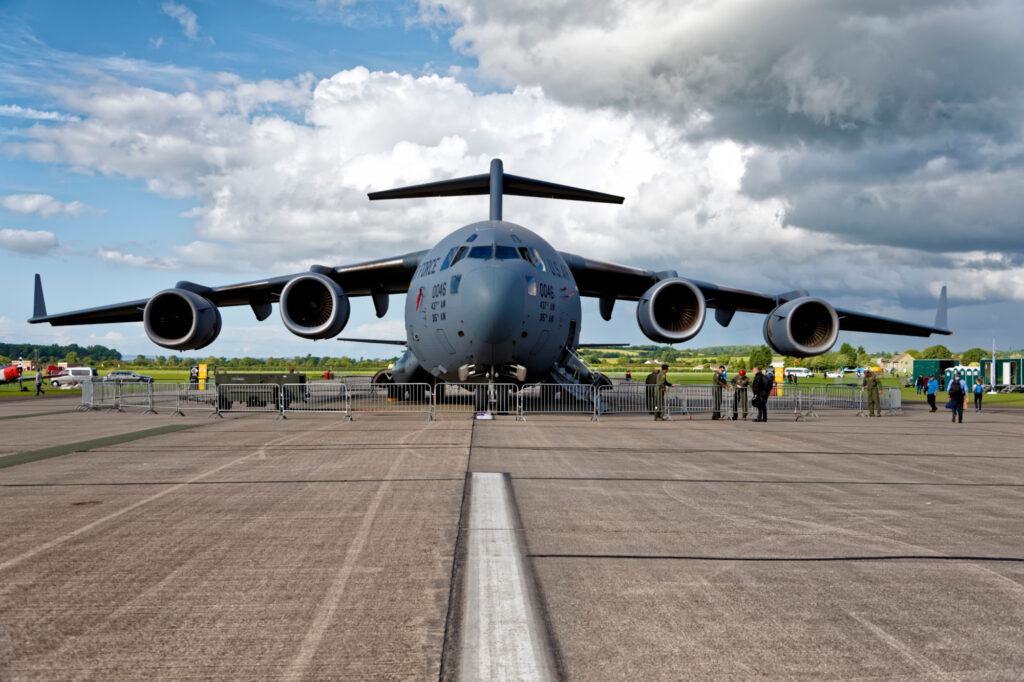
The story goes back to the mid-2000s, when the C-17 was introduced to Hawaii.
In February 2006, Hickam Air Force Base received its first C-17 Globemaster III, becoming the first U.S. base outside the continental United States to permanently host the aircraft. The arrival represented a major change for American air mobility operations in the Pacific.
The Hawaii Air National Guard was also transitioning from the older C-130 Hercules to the much larger and more capable C-17. According to the Hawaii Department of Defense, the transition was completed as part of a broader modernization effort that began years before the first aircraft arrived in Hawaii.
The C-17 was particularly valuable in Hawaii because of its ability to transport troops, vehicles and equipment over enormous distances while operating from relatively short runways. The aircraft can also perform tactical missions, including airdrops and operations from austere airfields.
By the end of 2006, Hickam was expected to have eight C-17s, operated and maintained jointly by the active-duty 15th Airlift Wing and the Hawaii Air National Guard’s 154th Wing.
A hangar designed for a very specific aircraft
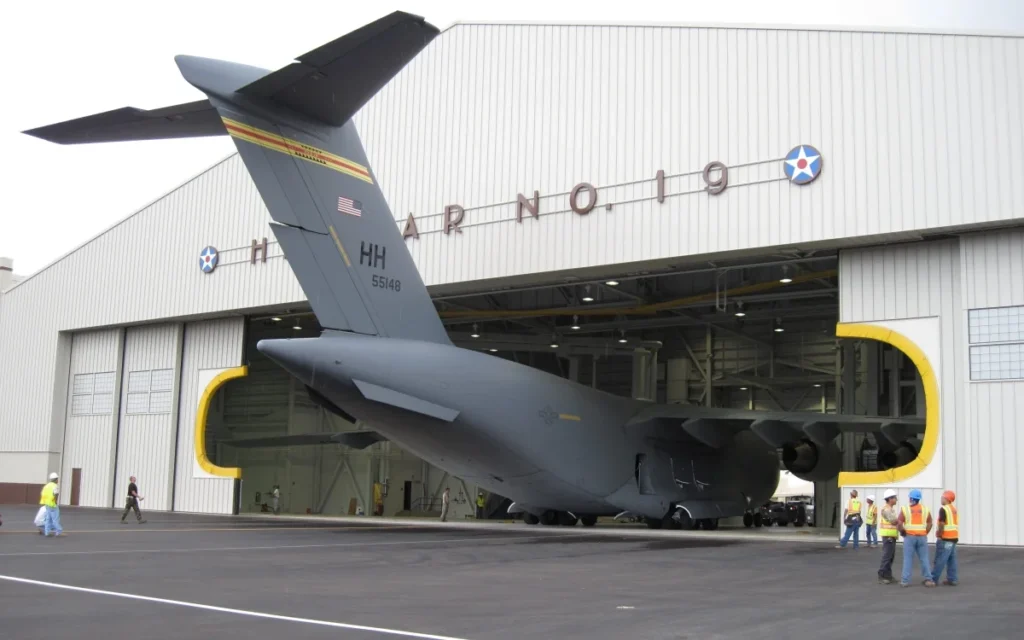
The strange-looking doors are associated with specialized C-17 maintenance facilities at Hickam.
One of these facilities is a C-17 fuel-cell nose dock hangar. Construction records describe it as a 32,016-square-foot facility, including a 22,000-square-foot hangar area. It was built to support maintenance of the C-17’s fuel system and was designed for continuous operations.
The building has a massive six-leaf sliding hangar door approximately 200 feet wide. But instead of simply creating an opening large enough to swallow the entire aircraft, the designers incorporated a special aperture into the door that fits around the C-17’s tail.
That is what creates the bizarre appearance seen in photographs: the hangar doors close around the aircraft while the vertical tail remains outside.
From a distance, it can look as though the C-17 is trapped halfway inside the building.
In reality, the arrangement is a deliberate solution to a difficult engineering problem.
Why not simply build a taller hangar?
A C-17 is an enormous aircraft. Increasing the height and dimensions of an existing hangar enough to accommodate its entire tail would require considerably more than simply replacing the doors.
The specialized design allows the facility to remain relatively compact while still providing a protected work environment for the majority of the aircraft.
The concept is not unique to Hickam. Specialized hangars around the world have used similar solutions when existing buildings or specific maintenance requirements make it impractical to enclose an entire aircraft.
At Hickam, however, the contrast is particularly striking because of the C-17’s enormous size and distinctive high-mounted tail.
Built for maintenance, not storage
It is also important to understand that this type of facility is not simply a giant garage for parking aircraft.
The C-17 fuel-cell nose dock was designed around maintenance work. Its facilities included systems for aircraft power, ventilation, fire protection, overhead lifting equipment and other specialized infrastructure required by maintenance crews.
Hickam also received a dedicated C-17 corrosion-control hangar designed for painting and general maintenance of the base’s fleet. U.S. Air Force records from the construction period describe the facility as supporting the eight C-17 aircraft assigned to Hickam.
This helps explain why the unusual doors exist. Their purpose is not to make the aircraft look as though it is squeezing through a doorway. They are part of a specialized maintenance environment designed around a very large aircraft.
A symbol of Hawaii’s strategic role
The arrival of the C-17 transformed Hickam’s role in Pacific air mobility.
Hawaii sits thousands of miles from the continental United States and occupies a central position between North America and Asia-Pacific. For military planners, that makes the islands an important hub for moving people, equipment and supplies across the region.
The C-17 was a natural fit for that mission. Its ability to combine strategic airlift with tactical capabilities made it considerably more versatile than the C-130 fleet it helped replace in Hawaii.
Today, Joint Base Pearl Harbor-Hickam remains one of the locations from which Pacific Air Forces operates C-17s.
An unusual piece of military engineering
The strange hangar doors at Hickam are a good example of how military infrastructure is often shaped by practical requirements rather than appearances.
To someone unfamiliar with the facility, the sight of a giant cargo aircraft with its tail sticking through a closed hangar door looks almost comical. But behind that unusual appearance is a carefully engineered solution to the challenge of maintaining one of the world’s largest military transport aircraft.
What looks like a hangar that is simply too small for its airplane is, in fact, a building designed around the airplane’s specific mission.
And that is precisely what makes the sight so fascinating: the bizarre-looking door is not an accident. It is the result of engineers adapting the building to the aircraft.