10 Best Self-Improvement Books to Read in 2026
The best self-improvement book is not the one with the most impressive ideas. It is the one that helps you make a specific improvement in how you spend your time, manage your attention, handle money, build relationships or make decisions—and then gives you a way to practise it.
This guide to the 10 best self-improvement books to read in 2026 focuses on books that remain useful beyond short-lived trends. Each recommendation solves a different problem, from inconsistent habits and digital distraction to poor financial decisions, weak boundaries and uncertainty about your next career move.
You do not need to read all ten. Choose the book that matches the problem currently costing you the most time, energy or opportunity. Then turn one idea into a small behaviour before moving on to the next title.
10 Best Self-Improvement Books to Read in 2026
1. Atomic Habits by James Clear
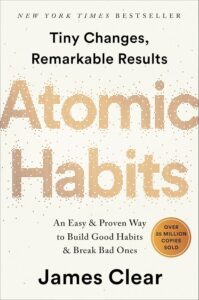
Best for: Building reliable habits and breaking unhelpful routines
Atomic Habits is one of the most accessible books about behaviour change. James Clear’s central idea is that small improvements become meaningful when they are repeated and supported by a good environment.
The book explains habits through four practical steps:
- Make the cue obvious
- Make the behaviour attractive
- Make it easy
- Make it satisfying
This framework is useful because it moves the focus away from willpower. If you repeatedly fail to exercise after work, the problem may not be a lack of ambition. Your gym clothes may be buried in a drawer, your workout may be too demanding, or the first step may require too much decision-making.
How to use it
Choose one behaviour and redesign the situation around it:
- Want to read more? Leave the book on your pillow before leaving the bedroom.
- Want to check your phone less? Charge it outside the bedroom.
- Want to train regularly? Prepare clothes and equipment the night before.
- Want to reduce takeaway food? Keep two quick meals available at home.
A useful exercise is habit stacking: attach a new action to something you already do. For example, after making your morning coffee, spend five minutes reviewing your priorities.
Watch out for: Treating tiny habits as a substitute for meaningful goals. Small actions are powerful when they are connected to a clear outcome, not when they become another productivity ritual.
Practical takeaway: Change the environment before blaming your discipline.
2. Deep Work by Cal Newport
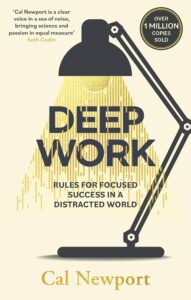
Best for: Concentration, demanding work and reducing digital distraction
Many people are busy all day yet make limited progress on work that requires thought. Deep Work argues that focused, distraction-free effort is increasingly valuable because it is difficult to perform and easy to interrupt.
Cal Newport distinguishes between:
- Deep work: Concentrated effort that improves your skills or produces something valuable
- Shallow work: Administrative tasks, routine messages and low-value activity that still consumes time
The point is not that emails, meetings or social media are always useless. The point is that they should not occupy every available hour.
How to use it
Start with one protected block rather than attempting an unrealistic transformation:
- Choose a task that requires concentration.
- Define what “finished” means before you begin.
- Put your phone in another room.
- Close unnecessary tabs and notifications.
- Work for 45–90 minutes.
- Record what you completed before switching tasks.
If your job involves constant communication, schedule a smaller block early in the day or during a predictable quiet period. A tradesperson, manager, student and freelancer may all use deep work differently, but each can protect some time for high-value thinking.
Watch out for: Confusing isolation with effectiveness. Some work depends on collaboration, and not every interruption is avoidable. The goal is to make focused work deliberate rather than accidental.
Practical takeaway: Identify the one task that would make the day materially better if completed, then give it your best attention before low-value tasks expand to fill the day.
3. Essentialism: The Disciplined Pursuit of Less by Greg McKeown
Best for: Overcommitment, weak boundaries and too many competing priorities
Essentialism is for people who keep saying yes and then wonder why their important goals receive only leftover energy. Greg McKeown’s approach is not simply “do less.” It is to decide what deserves your limited time and remove or reduce what does not.
The book is particularly useful when your problem is not laziness but an overloaded calendar.
How to use it
For every significant commitment, ask:
- If I could not do everything, would this still matter?
- What problem am I actually trying to solve?
- What is the cost of accepting this?
- Does this support one of my current priorities?
- What would I have to stop doing to make room for it?
Create three lists:
- Keep: Important responsibilities and goals
- Reduce: Activities worth doing less often or with lower standards
- Remove: Commitments that no longer justify their cost
This can apply to work projects, social obligations, subscriptions, group chats and even personal goals. You may discover that the issue is not that you need a better morning routine; it is that you have committed to five incompatible priorities.
Watch out for: Using “essentialism” as an excuse to avoid necessary responsibilities or difficult conversations. Selectivity requires clear decisions, not convenient avoidance.
Practical takeaway: Before adding a new goal, name what you will stop, reduce or postpone.
4. The Psychology of Money by Morgan Housel
Best for: Better financial behaviour and long-term decision-making
Money mistakes are often emotional and behavioural rather than mathematical. The Psychology of Money explores how personal history, status, fear, luck and risk influence financial decisions.
Morgan Housel’s book is useful even if you are not interested in investing. It encourages readers to think about:
- The difference between being wealthy and appearing wealthy
- Why financial security depends partly on flexibility
- How luck and risk affect outcomes
- Why reasonable financial decisions may be more sustainable than theoretically perfect ones
- The value of having a margin for unexpected events
A strong idea in the book is that money gives you options. Savings can create the ability to leave a bad job, handle an emergency or make a decision without immediate financial panic.
How to use it
Write a personal money policy covering:
- How much cash you want available for unexpected expenses
- Which debts you will prioritise
- What level of spending supports your actual life
- How you will avoid making major decisions based on comparison
- What financial risks you are unwilling to take
Use the book to improve your behaviour, not to seek a specific investment recommendation. Your income, obligations, country, tax system and risk tolerance all matter.
Watch out for: Treating a general personal-finance book as personalised financial advice. For country-specific guidance, taxes, pensions or investments, consult an appropriately qualified professional and use authoritative public resources.
Practical takeaway: Define what “enough” means for you. Without that definition, higher income can simply produce higher spending and more pressure.
Suggested external reference: The Consumer Financial Protection Bureau’s consumer resources can complement this book with practical information about budgeting, credit and financial decisions.
5. The Scout Mindset by Julia Galef
Best for: Clearer thinking, changing your mind and making better decisions
People often approach decisions like soldiers defending a position. Once they support an idea, they look for evidence that protects it and dismiss evidence that threatens it.
The Scout Mindset encourages a different approach: investigate what is true, even when the answer is inconvenient. Julia Galef presents intellectual humility as a practical decision-making skill rather than a sign of weakness.
This is especially useful when evaluating career plans, relationships, purchases, political claims or business ideas.
How to use it
When making a significant decision, separate these questions:
- What do I want to be true?
- What do I currently believe?
- What evidence would change my mind?
- What evidence am I ignoring?
- What is the downside if I am wrong?
- What would I advise a friend in the same situation?
You can also keep a decision journal. Record your assumptions, the possible outcomes and your level of confidence. Revisit it later. The aim is not to predict everything correctly; it is to improve the quality of your reasoning.
Watch out for: Endless analysis disguised as objectivity. Good thinking should eventually lead to a decision, experiment or next step.
Practical takeaway: Before arguing for your view, try to state the strongest case against it accurately.
6. How to Win Friends and Influence People by Dale Carnegie
Best for: Communication, relationships and handling conflict
First published in 1936, Dale Carnegie’s book remains relevant because its core subject is human attention. People want to feel respected, understood and taken seriously. Technical competence does not automatically produce trust.
The book focuses on practical behaviours such as:
- Listening instead of waiting for your turn to speak
- Showing genuine interest in other people
- Avoiding unnecessary criticism and humiliation
- Giving specific appreciation
- Discussing disagreements without turning them into personal attacks
- Framing requests around shared interests
For men who were taught to solve problems quickly, the book offers an important correction: sometimes people need recognition and understanding before they are ready to discuss solutions.
How to use it
In your next conversation, try three changes:
- Ask one follow-up question before offering advice.
- Repeat the other person’s main point in your own words.
- Replace “You always…” with a specific description of what happened and what you need next.
At work, this may improve a difficult conversation with a colleague. At home, it may prevent a disagreement from becoming a contest over who is right.
Watch out for: Treating social skills as manipulation. The useful principles depend on sincerity. Forced praise and calculated charm are usually easy to detect.
Practical takeaway: Make the other person feel heard before trying to make your point.
7. The 7 Habits of Highly Effective People by Stephen R. Covey
Best for: Personal responsibility, priorities and long-term effectiveness
Stephen Covey’s book is broader than a typical productivity manual. It presents effectiveness as a progression:
- Moving from dependence to personal responsibility
- Building effective relationships
- Developing cooperation
- Maintaining the ability to keep learning and contributing
Several of its ideas remain highly practical:
- Focus on what you can influence rather than what you can only complain about.
- Begin important work with the desired result in mind.
- Prioritise important activities instead of allowing urgent demands to control everything.
- Look for solutions that respect both your needs and other people’s needs.
- Understand before trying to be understood.
How to use it
Make a weekly “roles and priorities” review. List the roles you currently have—employee, partner, parent, friend, business owner or student—and choose one meaningful action for each role.
This prevents work from consuming your entire identity. It also exposes unrealistic expectations. If you have ten major priorities, you do not have ten priorities; you have a conflict that needs resolving.
Watch out for: Turning the habits into corporate language without changing your behaviour. The value lies in the weekly decisions they help you make.
Practical takeaway: Plan your week around important responsibilities, not merely the loudest incoming requests.
8. Designing Your Life by Bill Burnett and Dave Evans
Best for: Career uncertainty and choosing a more suitable direction
Many people approach career decisions as if there is one perfect answer they must discover. Designing Your Life uses design-thinking principles to make career planning more experimental and less dependent on one dramatic decision.
The authors encourage readers to test possibilities through small experiments rather than relying entirely on speculation.
How to use it
If you are considering a career change, do not begin by immediately rewriting your entire life. Start with low-risk research:
- Interview someone who already does the work.
- Take a short course or complete a small project.
- Volunteer or shadow someone where possible.
- Compare how different roles actually spend their time.
- Note which activities give you energy and which consistently drain it.
Create three possible five-year directions rather than one rigid plan. Then identify a small test for each option.
For example, someone considering a move into marketing might write a sample campaign, speak with two professionals and volunteer to help a local organisation. Real contact with the work is more informative than endlessly comparing job titles.
Watch out for: Assuming every career problem can be solved by “finding your passion.” Skills, health, money, location, responsibilities and labour-market conditions all matter.
Practical takeaway: Replace “What should I do with my life?” with “What small experiment would give me better information?”
9. Four Thousand Weeks: Time Management for Mortals by Oliver Burkeman
Best for: Time anxiety, unrealistic productivity and accepting limits
Four Thousand Weeks challenges the idea that the right productivity system will allow you to complete everything important. The title refers to the approximate length of an eighty-year life, not a precise prediction of anyone’s lifespan.
Oliver Burkeman’s argument is not anti-productivity. It is a warning that endless optimisation can become another way of avoiding difficult choices. Since time is limited, every commitment means not choosing something else.
How to use it
Try these exercises:
- Choose three activities that deserve your best attention this season.
- Set a limit on how many projects you will actively pursue.
- Finish one meaningful task before opening another project.
- Decide which worthwhile opportunities you will deliberately decline.
- Allow some tasks to remain incomplete without treating that as personal failure.
This book is particularly valuable for people who have read many productivity books but still feel behind. The solution may not be a better app or a more detailed schedule. It may be accepting that a finite life requires exclusion.
Watch out for: Using acceptance of limits as an excuse for passivity. The book asks you to choose more honestly, not to stop making an effort.
Practical takeaway: A full calendar does not prove that you are using your life well. Review whether your time reflects what you claim matters.
10. The Happiness Trap by Russ Harris
Best for: Difficult thoughts, emotional avoidance and living by personal values
The Happiness Trap introduces ideas from Acceptance and Commitment Therapy, commonly known as ACT. Its central message is that trying to eliminate every uncomfortable thought or feeling can make life narrower. A more useful goal is to notice internal experiences without allowing them to dictate every action.
The book is practical for people who regularly postpone important actions until they feel confident, motivated or calm.
How to use it
When an uncomfortable thought appears, try this sequence:
- Name the experience: “I am noticing the thought that I will fail.”
- Avoid treating the thought as a confirmed fact.
- Identify the value involved, such as courage, reliability, health or honesty.
- Choose one small action consistent with that value.
- Allow discomfort to be present while you act.
For example, someone avoiding an important conversation might acknowledge anxiety, clarify that honesty matters, and prepare one respectful sentence instead of waiting to feel fearless.
Watch out for: Treating a self-help book as a replacement for professional support. Persistent distress, serious symptoms or thoughts of self-harm require help from a qualified mental-health professional or an appropriate emergency service.
Practical takeaway: You do not need to feel ready before taking every worthwhile action. You need a clear value and a manageable next step.
How to Choose the Right Book and Apply Its Lessons to Create Lasting Change in 2026
The most common mistake is collecting self-improvement ideas without applying them. Reading can create a temporary sense of progress while your daily behaviour stays unchanged.
Use the following process to make one book useful.
Choose according to your current bottleneck
Pick the book that addresses the problem with the largest practical cost:
- You start habits but cannot maintain them: Atomic Habits
- You are distracted and producing shallow work: Deep Work
- Your calendar is overloaded: Essentialism
- Money creates anxiety or impulsive spending: The Psychology of Money
- You argue from instinct rather than evidence: The Scout Mindset
- Your relationships suffer from poor communication: How to Win Friends and Influence People
- You need a complete framework for priorities: The 7 Habits of Highly Effective People
- You are uncertain about your career direction: Designing Your Life
- You feel permanently behind: Four Thousand Weeks
- You avoid action until difficult feelings disappear: The Happiness Trap
Do not choose based only on the title you find most impressive. Choose the one connected to a problem you are prepared to work on now.
Read one book with a question in mind
Before opening the book, write one question such as:
- Why do I keep abandoning my training routine?
- What is taking my attention without producing much value?
- Which commitments should I remove?
- What financial behaviour is creating unnecessary pressure?
- What decision am I protecting from honest examination?
- What conversation am I avoiding?
A specific question gives you a filter. You are less likely to highlight every interesting sentence and more likely to notice ideas you can use.
Turn the book into a short experiment
At the end of each reading session, record:
- One idea: What principle seems most useful?
- One behaviour: What will I do differently?
- One trigger: When and where will I do it?
- One measure: How will I know whether it happened?
Example:
Idea: Reduce friction around exercise.
Behaviour: Walk for 20 minutes after work on Monday, Wednesday and Friday.
Trigger: Change into walking clothes immediately after arriving home.
Measure: Mark each completed walk on a calendar for four weeks.
This is more useful than highlighting an entire chapter.
Do not apply every idea at once
A book may contain ten good recommendations. Trying to implement all ten usually creates unnecessary complexity.
Choose:
- One behaviour to start
- One behaviour to stop or reduce
- One review point after two or four weeks
Once the behaviour feels manageable, add another change. The aim is not to build the perfect life in a weekend. It is to make the next decision easier and more reliable.
Match the method to your circumstances
Advice has to survive contact with real life. A parent, shift worker, business owner and university student will not use the same schedule. Adapt the principle without losing its purpose.
For example:
- “Do deep work in the morning” may become “protect the first quiet hour of my shift.”
- “Exercise every day” may become “complete three realistic sessions per week.”
- “Say no” may become “ask for 24 hours before accepting new commitments.”
- “Save more” may become “automate a manageable amount after payday.”
A method that fits your life imperfectly is usually better than an ideal method you cannot sustain.
Review results instead of relying on motivation
Set a date to review the experiment. Ask:
- Did I actually do the behaviour?
- What made it easier?
- What interrupted it?
- Was the action too large or too vague?
- Did it improve the problem I selected?
- Should I continue, modify or stop?
This prevents self-improvement from becoming an identity project. You are not trying to prove that you are disciplined. You are testing whether a change improves your actual life.
Common mistakes when reading self-improvement books
Reading too many books at once
Multiple frameworks can conflict and create confusion. One book applied carefully will usually outperform five books skimmed for inspiration.
Treating ideas as facts about your personality
A book may describe a useful pattern without explaining everything about you. Avoid using labels such as “I am just not disciplined” to close off further investigation.
Confusing information with change
Understanding a habit loop does not automatically change a habit. Change requires a behaviour, a context and repeated practice.
Copying someone else’s routine
A famous person’s morning routine may reflect their job, income, household and responsibilities. Borrow principles, not an entire lifestyle.
Ignoring trade-offs
Every improvement has a cost. More focus may mean fewer spontaneous interruptions. Better financial control may require less status spending. Stronger boundaries may disappoint some people. Make the trade-off consciously.
A practical 30-day reading plan
If you want a simple starting point, use this structure:
Days 1–3: Diagnose the problem
Write down the specific behaviour or decision you want to improve. Describe what currently happens and what it costs you.
Days 4–14: Read and extract
Read 10–20 pages at a time. After each session, capture one principle and one possible action. Do not build a giant notes system.
Days 15–28: Run one experiment
Apply one method from the book under normal conditions. Track completion, obstacles and results.
Days 29–30: Review
Decide whether to:
- Continue the behaviour
- Make it smaller
- Change the environment
- Try a different approach
- Move to another book because the original problem was misdiagnosed
A useful internal link would fit naturally here to a ManStuff101 article about building a practical daily routine, if one is available. Other relevant internal-link opportunities include articles about setting boundaries, improving focus or managing personal finances. These should be added only where matching ManStuff101 articles already exist.
Frequently Asked Questions
Which self-improvement book should I read first in 2026?
Start with Atomic Habits if your main issue is inconsistent behaviour. Choose Deep Work if distraction is the bigger problem, The Psychology of Money if financial decisions are causing stress, or Designing Your Life if you are uncertain about your career direction.
Are older self-improvement books still worth reading?
Yes, when their principles address enduring human problems. The 7 Habits of Highly Effective People and How to Win Friends and Influence People are older books, but responsibility, communication and priorities remain relevant. Read older advice critically and adapt examples that no longer fit modern work or culture.
How many self-improvement books should I read in a year?
There is no useful universal number. A better target is to read one book, apply one or two ideas, review the results and then decide whether another book is necessary. Reading fewer books with deeper application is often more valuable than finishing a long list.
Should I listen to these books as audiobooks?
Audiobooks work well for broad ideas and first passes, especially during commuting or walking. For books containing exercises, frameworks or detailed examples, a printed or digital copy may make it easier to pause, annotate and practise the material.
What if a self-improvement book makes me feel worse?
Stop treating the book as an authority over your life. Some advice may not suit your situation, and productivity-focused material can increase pressure if you are already exhausted or overwhelmed. Take the useful principle, reject what does not fit and seek qualified support if distress is persistent or severe.
Is self-improvement only about productivity?
No. Productivity is only one category. Better self-improvement can also mean clearer decisions, healthier boundaries, stronger relationships, financial resilience, career exploration or acting according to your values even when circumstances are uncomfortable.
IMAGE SUGGESTION:
A man choosing between several self-improvement books beside a notebook and coffee, representing the 10 best self-improvement books to read in 2026.
ALT TEXT: Man choosing from the best self-improvement books to read in 2026
IMAGE SUGGESTION:
A close-up of an open book with handwritten notes, a weekly planner and a pen, showing how to turn reading into practical action.
ALT TEXT: Notes and weekly plan for applying self-improvement book lessons
IMAGE SUGGESTION:
A quiet desk with a phone placed away from a laptop while someone reads, illustrating focused reading and deep work.
ALT TEXT: Focused reading setup for personal growth and better concentration
IMAGE SUGGESTION:
A simple decision journal beside a calculator, wallet and notebook, connecting personal development with financial and everyday decision-making.
ALT TEXT: Decision journal and personal finance notes for practical self-improvement
These ten books cover different problems rather than offering one universal formula. Atomic Habits helps you design repeatable behaviour. Deep Work protects concentration. Essentialism helps you choose fewer priorities. Other books address money, communication, career uncertainty, emotional discomfort and the limits of time.
The most useful next step is to choose one title based on your current bottleneck, write down the question you want it to answer and select one behaviour to test for the next 30 days. Do not measure success by how many pages you finish. Measure it by whether one important part of your everyday life works better.