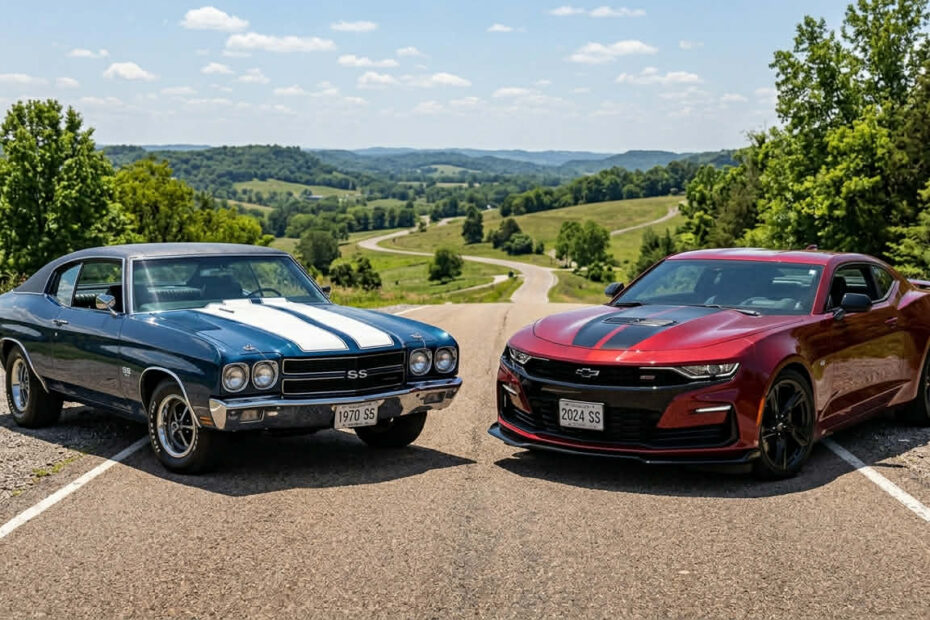
Overview of Classic Muscle Cars
“Better” depends on what you value. Classic muscle cars and modern muscle cars deliver very different experiences, even when they share the same badges.
What Counts as a Muscle Car?
Traditionally, muscle cars are American midsize or coupe cars with large-displacement engines focused on straight-line speed and aggressive styling. Examples include:
- 1969 Dodge Charger
- 1970 Chevrolet Chevelle SS
- 1971 Plymouth ‘Cuda
Modern muscle cars evolved that formula with current engineering:
- Ford Mustang Dark Horse
- Dodge Challenger SRT Hellcat
- Chevrolet Camaro ZL1
Classic Muscle Cars
Strengths
1. Raw Driving Feel
Classic muscle cars are mechanical and analog:
- Heavy steering
- Loud V8s
- Minimal driver aids
- Simple interiors
Many enthusiasts love the visceral connection to the car.
2. Styling and Presence
Classic muscle cars have iconic proportions:
- Long hoods
- Chrome trim
- Aggressive body lines
Cars like the 1967 Shelby GT500 or 1970 Dodge Challenger R/T are rolling pieces of automotive history.
3. Collectibility
Well-kept classics can appreciate significantly in value. Rare trims, matching-number engines, and limited-production models are especially sought after.
4. Simplicity
Older engines are easier to work on mechanically:
- Fewer electronics
- Easier DIY maintenance
- Huge aftermarket support
Weaknesses
1. Reliability
Classic cars typically require:
- Frequent maintenance
- Carburetor tuning
- Attention to leaks, rust, and aging parts
They’re often weekend cars, not ideal daily drivers.
2. Safety
Most classics lack:
- Airbags
- Stability control
- Modern crash protection
- ABS braking
By modern standards, they’re far less safe.
3. Performance Limits
Despite their legendary reputation, many classic muscle cars:
- Struggled with braking
- Had poor cornering
- Produced less real-world performance than modern cars
A modern V6 sports coupe can outperform many original muscle cars.
Modern Muscle Cars
Strengths
1. Massive Performance
Modern muscle cars are incredibly fast.
For example:
- Dodge Challenger SRT Demon 170
- Ford Mustang GTD
These cars can produce supercar-level acceleration while remaining street legal.
2. Better Handling and Braking
Modern suspension, tires, and electronics dramatically improve:
- Grip
- Cornering
- Stability
- Braking distance
3. Comfort and Technology
Modern muscle cars offer:
- Heated/cooled seats
- Touchscreens
- Adaptive cruise control
- Smartphone integration
- Drive modes
You can comfortably road-trip them daily.
4. Reliability
Modern engines and transmissions are generally:
- More dependable
- More fuel-efficient
- Easier to live with year-round
Weaknesses
1. Less “Pure” Feel
Some enthusiasts feel modern cars:
- Rely too much on electronics
- Feel heavier and more isolated
- Lose the raw character of older machines
2. Complexity
Modern cars are harder to repair yourself because of:
- ECUs
- Sensors
- Emissions systems
- Software integration
3. Depreciation
Most new muscle cars lose value initially, unlike certain classics that appreciate.
Side-by-Side Comparison
| Category | Classic Muscle Cars | Modern Muscle Cars |
|---|---|---|
| Driving Feel | Raw and mechanical | Refined and controlled |
| Straight-Line Speed | Strong for the era | Extremely fast |
| Handling | Usually weak | Excellent |
| Reliability | Lower | Higher |
| Safety | Minimal | Advanced |
| Maintenance | Easier mechanically | Easier ownership overall |
| Technology | Basic | Modern features |
| Collectibility | Often high | Select models only |
| Daily Driving | Difficult | Practical |
| Fuel Economy | Poor | Better (relatively) |
Which Is Better for Different Buyers?
Choose Classic Muscle Cars If You:
- Love automotive history
- Enjoy wrenching on cars
- Want a collectible
- Prefer analog driving experiences
- Drive mostly for fun/weekends
Choose Modern Muscle Cars If You:
- Want extreme performance
- Need reliability and comfort
- Plan to daily drive
- Value safety and technology
- Want track-ready capability
The Middle Ground: Restomods
Some enthusiasts combine both worlds through “restomods”:
- Classic body
- Modern engine
- Modern brakes/suspension/interior
Examples include builds based on:
- 1969 Chevrolet Camaro
- 1968 Ford Mustang Fastback
These offer vintage looks with modern drivability.
Bottom Line
- Classic muscle cars are about emotion, nostalgia, sound, and presence.
- Modern muscle cars are objectively superior in performance, safety, and usability.
If your goal is the purest emotional driving experience, classics often win.
If your goal is speed, convenience, and all-around capability, modern muscle cars are usually the better choice.