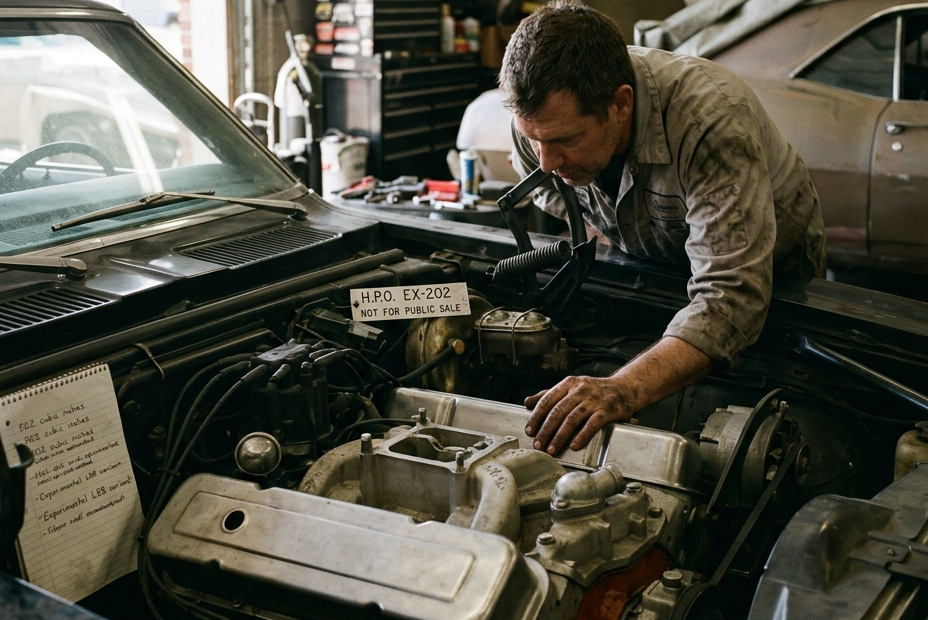
Discover the legendary factory-backed muscle car powertrains that officially shouldn’t have existed. From COPO Chevys and Boss Mustangs to the Street Hemi, uncover Detroit’s hidden horsepower wars and secret performance options.
The golden age of American muscle cars wasn’t just about horsepower—it was about deception, loopholes, and engineering rebellion. Behind the glossy brochures and official specifications, Detroit’s biggest automakers were quietly building machines that broke corporate rules, sidestepped racing bans, and delivered performance levels that executives publicly claimed they didn’t support.
These were the shadow factory options: secret engine packages, special-order performance cars, and race-ready powertrains that technically weren’t supposed to exist. Today, they rank among the most valuable and sought-after muscle cars ever built.
The Corporate Horsepower Wars of the 1960s
During the late 1960s, American automakers found themselves trapped between public image concerns, insurance pressures, and fierce competition on the drag strip. Companies publicly distanced themselves from racing while privately fueling an escalating horsepower war.
One of the most famous restrictions came from General Motors, which imposed a policy limiting intermediate-sized vehicles to engines no larger than 400 cubic inches. Officially, it was meant to discourage factory racing involvement.
Unofficially, enthusiasts and engineers found ways around it.
The result was an underground world of factory-approved performance machines that blurred the line between production cars and race cars.
COPO Chevrolet: The Secret Ordering System That Changed Muscle Car History
No discussion of hidden factory power would be complete without the legendary COPO program.
The Central Office Production Order (COPO) system was originally designed for fleet and commercial vehicle requests. However, clever dealers realized it could be used to order combinations that weren’t listed in standard sales catalogs.
The most famous example was the Chevrolet Camaro COPO 9561.
Through COPO channels, select buyers could order a Camaro equipped with Chevrolet’s fearsome 427-cubic-inch big-block V8—an engine that officially wasn’t available in the Camaro lineup.
Why the COPO Camaro Was So Special
- Factory-installed 427 big-block engine
- Built specifically for drag racing dominance
- Significantly underrated horsepower ratings
- Produced in extremely limited numbers
- Became one of the rarest muscle cars ever built
Although officially rated around 425 horsepower, many experts estimate actual output exceeded 500 horsepower with race tuning.
The COPO Camaro became a giant killer on drag strips across America and remains one of the most collectible classic muscle cars ever produced.
The Boss 429 Mustang: Ford’s NASCAR Homologation Masterpiece
While Chevrolet used ordering loopholes, Ford Motor Company pursued a different strategy.
The legendary Ford Mustang Boss 429 was created primarily to homologate Ford’s massive semi-hemispherical 429 engine for NASCAR competition.
Officially, it was a production Mustang.
In reality, it was closer to a street-legal race car.
What Made the Boss 429 So Extreme?
The engine was so large that extensive modifications were required before it could fit inside the Mustang chassis. Specialized contractors performed significant structural changes, making each car far more complex than a standard production model.
Factory ratings listed horsepower at 375.
Most enthusiasts and historians agree the true output was substantially higher.
The Boss 429 represented one of the most sophisticated examples of Detroit’s willingness to bend production rules in pursuit of racing success.
Chrysler’s Street Hemi: The Underrated Monster
Few engines carry as much mystique as Chrysler’s legendary Street Hemi.
The 426 Street Hemi was essentially a race-bred powerplant adapted for street use. Its hemispherical combustion chamber design provided exceptional airflow and unmatched high-RPM performance.
Official horsepower figures were remarkably conservative.
Why Was the Street Hemi Underrated?
Automakers often intentionally published lower horsepower numbers for several reasons:
- Reduced insurance scrutiny
- Improved reliability perceptions
- Racing politics
- Marketing strategies
The Street Hemi was officially rated at 425 horsepower.
Independent testing and modern dyno evaluations frequently suggest real-world output was significantly higher.
This created one of the most feared street engines of the muscle car era and helped establish Chrysler’s reputation for producing brutally fast factory vehicles.
The Art of Horsepower Underrating
One of Detroit’s favorite tricks involved publishing conservative horsepower ratings.
Before standardized testing methods, manufacturers could manipulate testing conditions to produce lower numbers while still advertising impressive performance.
Many legendary muscle cars were substantially more powerful than their official specifications suggested.
Examples include:
- COPO 427 Chevrolets
- Street Hemi Mopars
- Boss 429 Mustangs
- 428 Cobra Jet Fords
- Ram Air Pontiac models
These understated figures allowed manufacturers to satisfy corporate policies while still delivering maximum performance to customers who knew what they were buying.
Why These Secret Muscle Car Engines Matter Today
Shadow factory options represent a unique chapter in automotive history.
They demonstrate how engineers, dealers, and performance enthusiasts worked together to outsmart corporate restrictions and create some of the most iconic muscle cars ever built.
Today, these rare machines command enormous values at auctions because they combine:
- Limited production numbers
- Authentic racing heritage
- Factory-backed performance
- Historical significance
- Legendary horsepower
For collectors, owning one of these hidden-performance icons means owning a piece of Detroit’s underground horsepower revolution.
Final Thoughts
The greatest muscle cars weren’t always the ones advertised on showroom posters. Some of the most legendary machines emerged through secret ordering systems, loopholes, and carefully disguised performance packages.
Whether it was a COPO Camaro hiding a massive 427, a Boss 429 built for NASCAR dominance, or a Street Hemi quietly producing more power than advertised, these shadow factory creations proved that Detroit’s engineers were often just as rebellious as the racers who drove them.
Their legacy lives on as some of the most desirable, powerful, and fascinating muscle cars ever built.
Additional High-Traffic SEO Keywords
- rare muscle cars
- hidden horsepower legends
- classic American muscle cars
- factory drag racers
- muscle car collector guide
- biggest V8 engines ever made
- vintage performance cars
- Detroit muscle car history
- rare factory engine options
- street legal race cars
- muscle car auction values
- iconic American V8 engines
- classic car investment opportunities
- best muscle cars of all time
- legendary factory performance packages