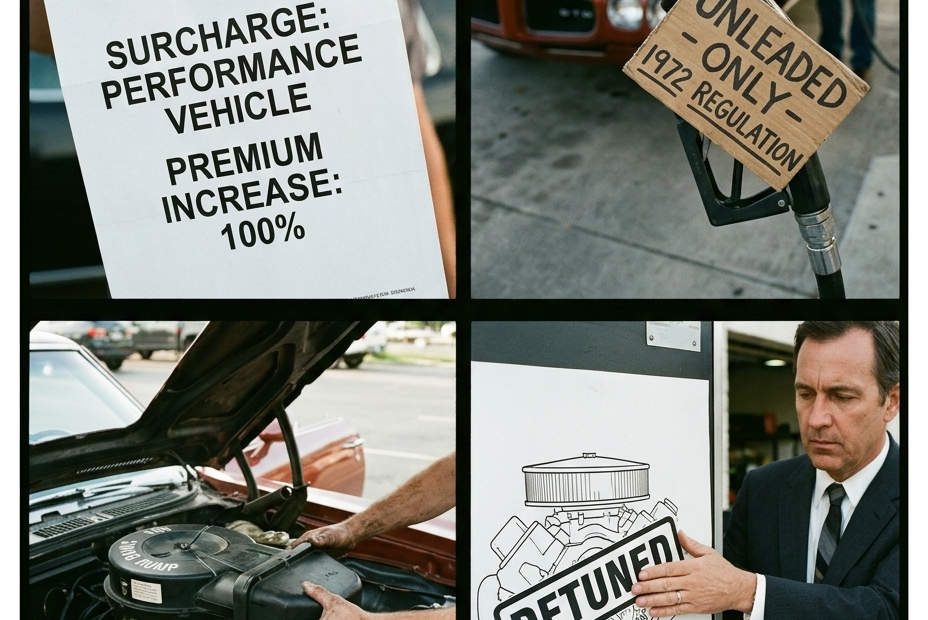
In the summer of 1970, Detroit was the undisputed king of the concrete jungle. You could walk into a local dealership with a modest paycheck and drive out in a functional missile disguised as a street car—a dual-quad, high-compression big block capable of shredding bias-ply tires straight off the showroom floor. The horsepower wars had reached an absolute fever pitch, with manufacturers trading punches via cubic inches and radical aerodynamic body kits.
But look closer at the historical record, and you’ll find a sudden, violent shift. Enthusiasts often look back at the early 1970s as a slow, natural evolution toward fuel efficiency. The brutal truth is far more clinical. The golden era didn’t fade away; it was systematically assassinated by a lethal three-way crossfire of corporate accounting shifts, federal environmental mandates, and predatory insurance premiums. By 1972, the high-compression monster was officially dead.
To understand the sudden onset of the “Malaise Era”—the dark, detuned period of automotive history that followed—one must look at the specific year 1972. It marks the precise chronological fault line where American performance collapsed under its own weight.
1. The Overnight Illusion: Gross vs. Net Horsepower Ratings
If you flip through an automotive catalog from 1971 and compare it to 1972, you will notice something terrifying. On paper, it appeared as though American car manufacturers lost up to 100 horsepower per engine overnight. For example, the legendary Chevrolet 454 LS5 big-block plunged from a fierce 365 horsepower down to just 270 horsepower.
However, this massive drop was largely an illusion dictated by a mandatory industry shift in how power was measured. Before 1972, Detroit utilized the SAE Gross horsepower standard. Under this protocol, engines were tested in an absolute vacuum of optimized laboratory conditions:
$$\text{HP}_{\text{Gross}} = \text{HP}_{\text{Engine}} – (\text{Zero Restrictions})$$
Engineers tested these powerplants without power steering pumps, alternators, water pumps, air filters, or factory exhaust systems. Furthermore, they were tuned with optimal laboratory headers and advanced ignition timing that no production line car could ever run safely on the street.
In 1972, the Society of Automotive Engineers mandated the implementation of the SAE Net power standard. This required engines to be tested exactly as they sat installed inside a real production vehicle—choked by restrictive factory mufflers, driving full accessory belts, and operating with a standard air cleaner assembly intact:
$$\text{HP}_{\text{Net}} = \text{HP}_{\text{Gross}} – \Delta\text{HP}_{\text{Accessories}} – \Delta\text{HP}_{\text{Exhaust}}$$
While the physical engines didn’t actually lose 30% of their power on day one of the rule change, the marketing power vanished instantly. Buyers walked into showrooms, saw the severely deflated numbers on the window stickers, and realized the psychological spell of the muscle car wars had been broken.
2. Choked Out: Smog Regulations and Unleaded Fuel Requirements
While the change from gross to net ratings altered the numbers on paper, actual physical performance was simultaneously being strangled by Washington D.C. The passage of the Clean Air Act of 1970 handed immense regulatory oversight to the newly formed Environmental Protection Agency (EPA). The mandate was clear: clean up automotive tailpipe emissions immediately.
To meet these early emissions standards, engineers had to drastically reduce oxides of nitrogen and unburned hydrocarbons. The most effective weapon available at the time was the implementation of unleaded fuel, setting the stage for the eventual introduction of catalytic converters.
The High-Compression Nightmare
True muscle cars relied entirely on heavy doses of tetraethyl lead in high-octane gasoline. Lead acted as a natural lubricant for engine valves and, more importantly, served as an anti-knock agent that prevented destructive pre-ignition in engines running compression ratios as high as $10.5:1$ or $11.0:1$.
When federal mandates forced oil companies to phase out leaded fuel, compression ratios had to be slashed to allow engines to run on low-octane, unleaded pump gas without destroying themselves. Over the span of a single model year, compression ratios plummeted across Detroit down to pedestrian levels of $8.2:1$ or lower.
Slashing the compression ratio immediately took the teeth out of the V8 engine. Camshaft profiles were altered to be less aggressive, ignition timing was heavily retarded, and carburetors were tuned to run incredibly lean. The high-breathing, high-revving muscle cars of 1969 were replaced by hot-running, choked engines that struggled to breathe past 4,000 RPM.
3. The Financial Wall: Skyrocketing Insurance Premiums
Even if an enthusiast was willing to overlook the lower horsepower ratings and the detuned, low-compression engines, they ran face-first into an insurmountable financial barrier: the insurance industry.
By 1970, actuarial tables had caught up with the muscle car phenomenon. Actuaries realized that handing a 19-year-old male the keys to a 3,800-pound vehicle armed with a 426 Hemi or a Ram Air IV 400 V8 was a recipe for catastrophic financial loss. Accident rates were climbing, stolen vehicle reports were shifting disproportionately toward performance models, and repair costs for heavily damaged sheet metal were tearing into corporate profit margins.
In response, insurance conglomerates unleashed punitive surcharges specifically targeted at muscle cars. They instituted a “performance penalty” that often added a 50% to 100% premium hike if a vehicle possessed certain identifiers—such as functional hood scoops, specific trim designations (like SS, R/T, GT, or Judge), or a displacement exceeding 400 cubic inches.
In many documented cases, a young driver’s annual insurance premium for a brand-new muscle car exceeded the actual monthly loan payment for the vehicle itself. A generation of young buyers who formed the financial bedrock of the muscle car market was completely priced out of the driver’s seat by insurance companies overnight.
The Post-Mortem Metric
| Engine Platform | 1907/71 Gross Output | 1972 Net Output | Typical Compression Drop | Primary Death Factor |
| Chevrolet 454 CI Big Block (LS5) | 365 Gross HP | 270 Net HP | $10.25:1 \rightarrow 8.5:1$ | Unleaded Fuel & SAE Shift |
| Chrysler 426 CI Hemi “Elephant” | 425 Gross HP | 350 Net HP (1971)* | $10.25:1 \rightarrow$ Discontinued | Insurance Costs & Smog Ban |
| Pontiac 455 CI Super Duty / HO | 335 Gross HP | 300 Net HP | $10.5:1 \rightarrow 8.4:1$ | EPA Tailpipe Standard |
| Ford Boss 351 / 351 Cobra Jet | 330 Gross HP | 266 Net HP | $11.0:1 \rightarrow 8.8:1$ | Low Octane Mandate |
*Note: Chrysler pulled the plug on the 426 Hemi at the end of 1971 because it could not pass the impending 1972 tailpipe standards without a complete redesign.
Conclusion: The Dawn of the Malaise Era
By the time the 1972 model year concluded, the landscape was unrecognizable. The legendary muscle cars hadn’t just undergone an aesthetic change; they had been fundamentally hollowed out. High-impact colors with names like “Plum Crazy” and “Grabber Blue” were phased out in favor of earth tones—earth browns, muted greens, and beige tones that perfectly mirrored the somber mood of American car performance.
The golden era was over. It would take nearly fifteen years of computer-controlled electronic fuel injection, advanced metallurgy, and modern engine management systems for Detroit to safely claw its way back to the true performance figures that were stripped away in the historic wipeout of 1972.